
Flavelle Oceanfront District: What 2400 Murray Street Means for Port Moody
34 waterfront acres at the eastern end of Murray Street. A 120-year sawmill closed. A master plan approved in concept. Eleven towers, 3,397 potential homes, 7.54 acres of new park — and not a single shovel in the ground yet. Here is the honest local read on what Flavelle is, what it is not, and what it means for Port Moody real estate today.
TL;DR — what's approved, what's not, the realistic timeline
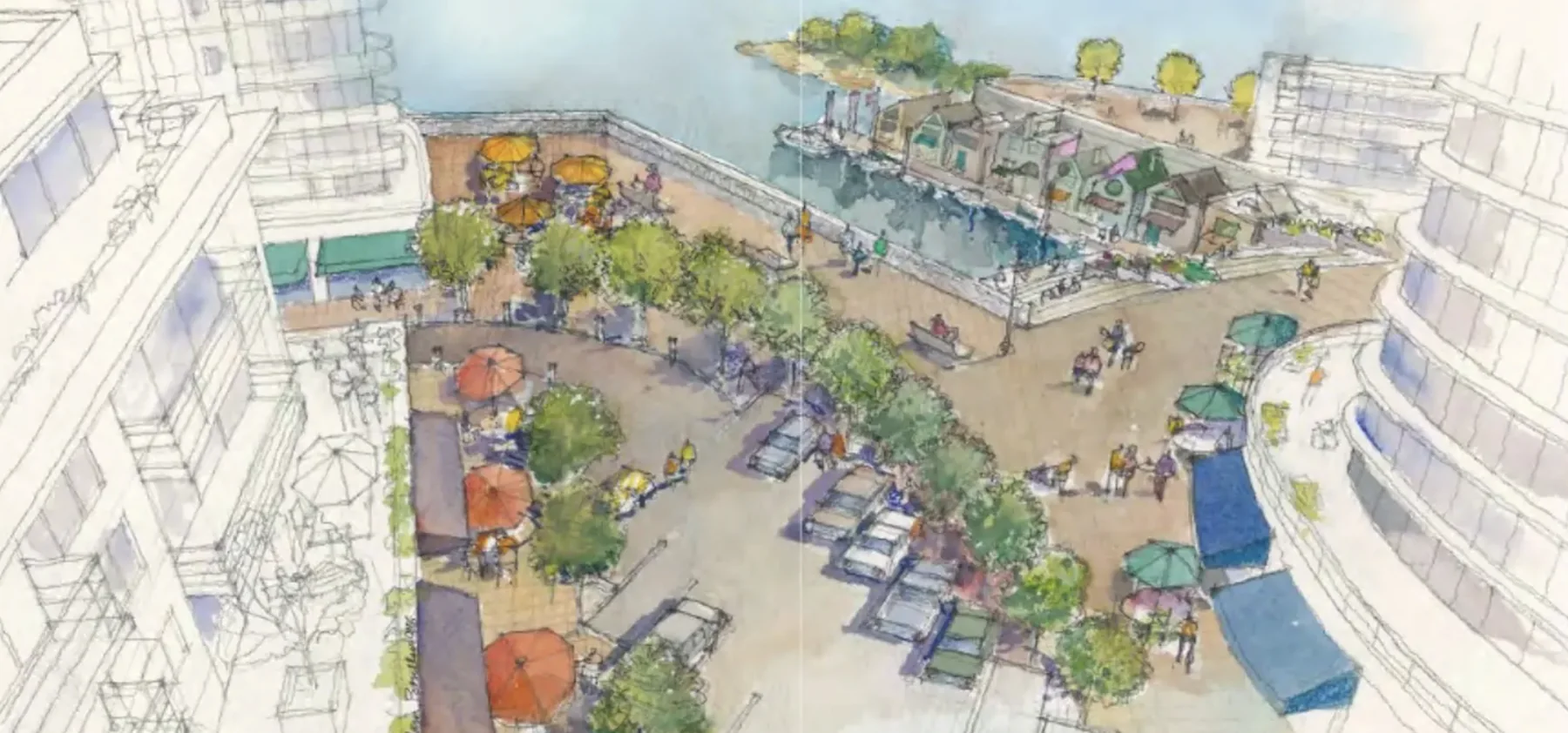
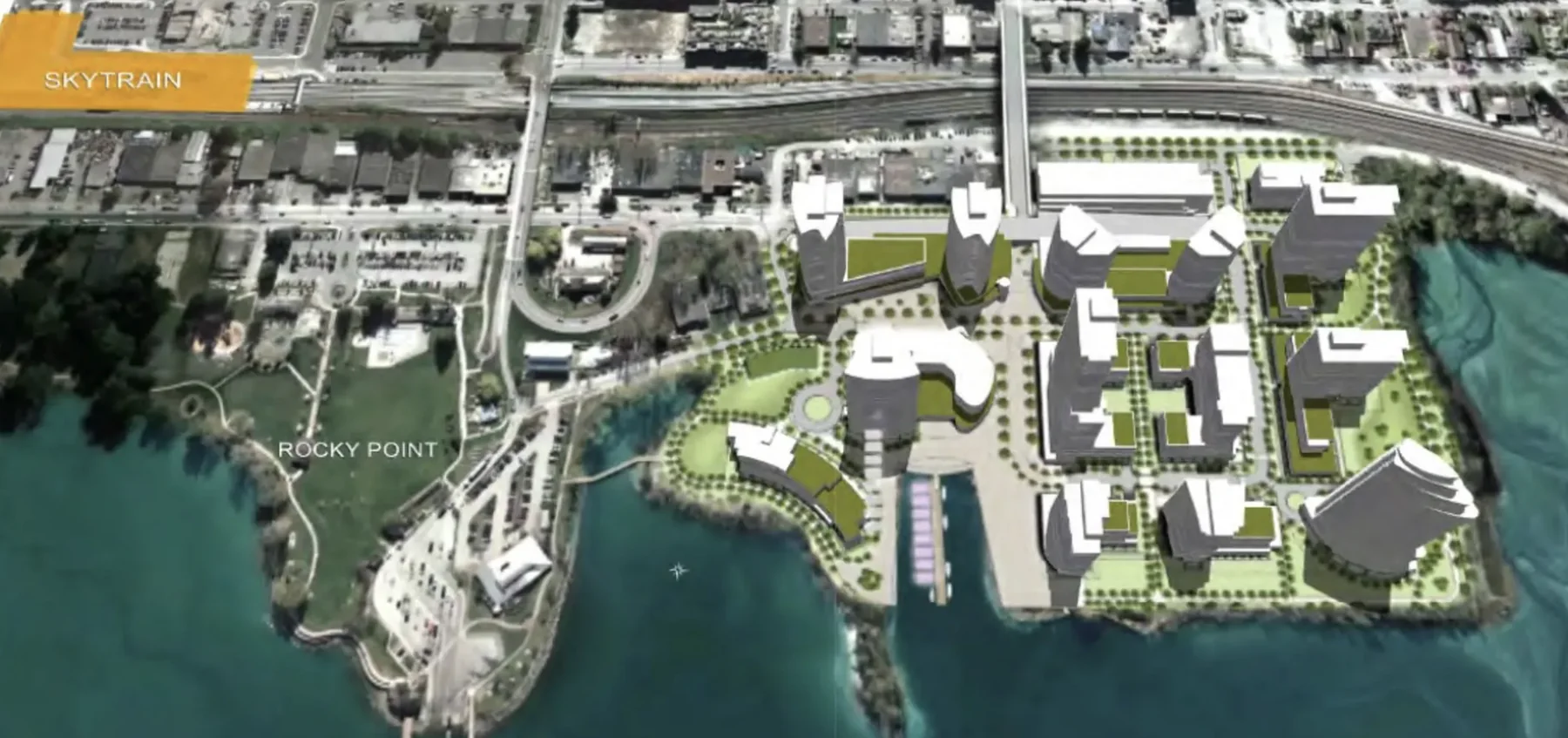
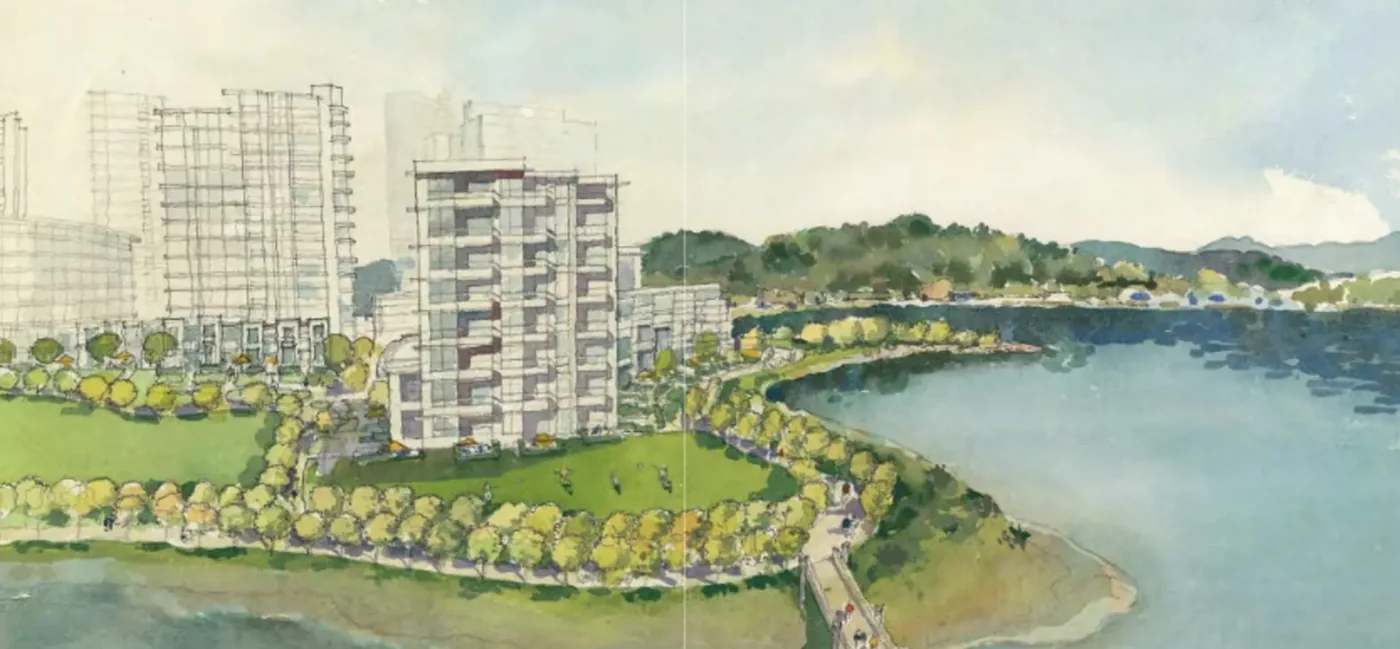
Approved (in concept, June 12, 2018): Port Moody Council amended the Official Community Plan to designate the 34-acre Flavelle site at 2400 Murray Street as the Oceanfront District. The OCP envelope allows up to 3,397 residential units across 11 towers (16 to 38 storeys), one 8-storey mid-rise, 75 live-work units, 62 rental units, and roughly 455,000 sq ft of employment-generating space, with 7.54 acres of new public park and a continuous waterfront boardwalk.
NOT yet approved: A formal rezoning application, a development permit, or any construction permits. Port Moody's 2050 OCP update is heading to public hearing in January 2026 with final adoption targeted March 2026 — that conversation happens before any Flavelle-specific rezoning advances.
Realistic timeline: A 34-acre, 11-tower master plan is phased over 15 or more years post-rezoning. Marketing aggregators that quote a 2028 completion are not citing a verified source — treat that number as aspirational, not factual. Flavelle is a long-term Port Moody story, not a 2027 listing event.
The 34-acre story: site, geography, and a 120-year mill
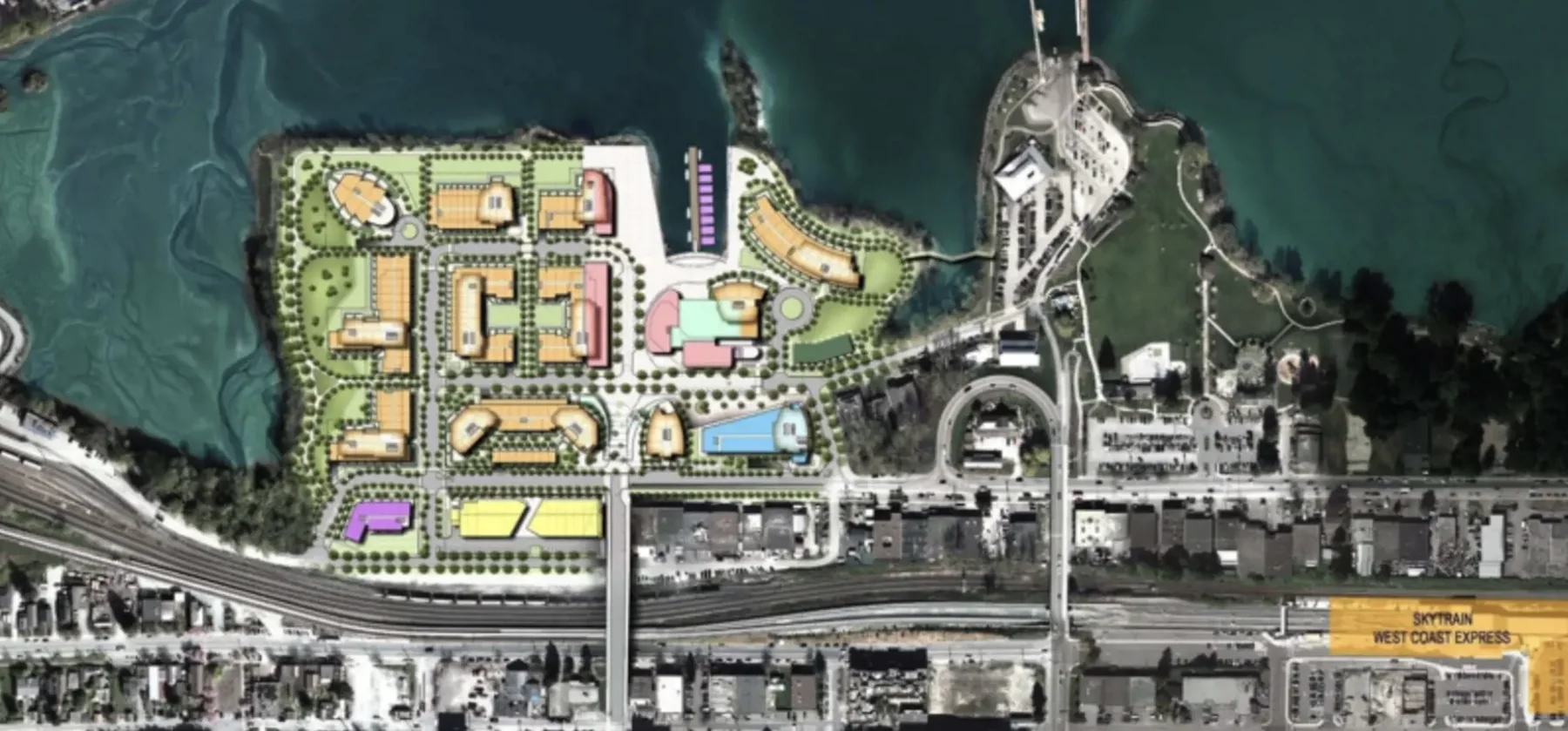
If you have ever walked east along Murray Street from Brewers Row, kept going past the lumber yards, and ended up at the gates of a working sawmill — that mill is Flavelle. The site sits at 2400 Murray Street (some marketing materials reference 2450 Columbia Street for the upland edge), and it occupies the entire 34-acre block from the Burrard Inlet shoreline up to Columbia Street. Rocky Point Park is the eastern neighbour. Pacific Coast Terminals is the western neighbour. Moody Centre SkyTrain on the Millennium Line and the West Coast Express are both within walking distance.
The mill itself has been part of Port Moody since 1905. It started as the Emerson Cedar Mill, became Thurston-Flavelle, then Flavelle Cedar — one of British Columbia's longest-operating waterfront sawmills. For 120 years, the rhythm of the Inlet's eastern edge was built around log booms, cedar siding, and the smell of fresh-milled timber drifting up toward Heritage Mountain.
That ended in late 2020 / 2021. The closure was not about cedar prices or demand — it was a math problem. Ownership cited a tax and water-lot-lease squeeze: property taxes climbed from roughly $1.6 million to $2.4 million, and combined with rising water-lot lease costs the all-in annual carrying cost approached $3 million. At that level, even a long-tenured working mill on a healthy site stops making sense as a mill. So Aspen Planers Group — the owner — pivoted. Aspen Enterprises is the real-estate arm now advancing the redevelopment.
That is the first piece of context. The shift from sawmill to master-planned waterfront village is not a "developer scooping up a sleepy industrial site." It is the second act of a property whose owner ran out of room to keep operating it the way it had been operated for a century.
What was actually approved (and what an OCP amendment really does)
On June 12, 2018, Port Moody Council amended its Official Community Plan and formally designated the Flavelle site as the "Oceanfront District." That is an important date — and an important distinction.
An OCP amendment is a planning-level approval. In plain English, it says: "Council agrees this site should be reimagined for this kind of use, at roughly this density, with these public amenities baked in." It sets the envelope. It signals the political direction. It tells the developer that a future formal rezoning application aimed at this vision will be evaluated against a yes-this-is-the-plan baseline rather than a no-this-doesn't-fit baseline.
What an OCP amendment does not do:
- It does not rezone the land. The site's underlying zoning is still industrial. A formal rezoning application — with full public hearings — has not yet been submitted.
- It does not grant a development permit. No specific building heights, setbacks, or site-plan details are locked in at OCP stage.
- It does not grant a building permit. Nothing can be built from an OCP amendment alone.
- It is not unchangeable. Council can revisit, refine, or layer new conditions onto the framework — and the Port Moody 2050 OCP update is doing exactly that.
This is the single most important fact about Flavelle in 2026: the project is approved in vision, not in construction. Anyone marketing units, quoting prices, or naming a tower at Flavelle right now is selling something that does not legally exist yet.
The master plan in plain English
Here is what the approved OCP envelope allows, translated out of planning-speak.
Homes — 3,397 units in mostly tall towers
- Up to 3,397 residential units at full build.
- ~96% of those units sit in 11 towers ranging from 16 to 38 storeys. This is the height of the Port Moody skyline conversation in one number — 38 storeys is taller than anything currently standing in the city.
- One 8-storey mid-rise in addition to the towers.
- 75 live-work units — homes designed for residents who run a ground-floor business out of the same building.
- 62 rental units in a dedicated low-rise rental building. This is a relatively small slice of the total, but it is the only purpose-built-rental piece in the envelope.
Jobs and economic base — 455,000 sq ft of employment space
- About 455,000 sq ft of employment-generating space — retail, office, and urban light industrial.
- Roughly 1,000 on-site jobs at full build. That is the deliberate "complete community" piece of the plan: people who live at Flavelle should be able to work there too, and people from across Port Moody and the Tri-Cities should have somewhere to commute to.
Public amenities — the headline number is 7.54 acres of park
This is where the plan distinguishes itself from a standard density play. Aspen and WA Architects committed to 7.54 acres of new park and conservation area — that is about five times the city's zoning requirement. To put it in scale: that 7.54-acre figure is roughly equivalent to the green area of Rocky Point Park next door. Port Moody would essentially be gaining a second Rocky Point Park as part of this build.
The 7.54 acres breaks down as:
- Four park areas totalling 4.9 acres.
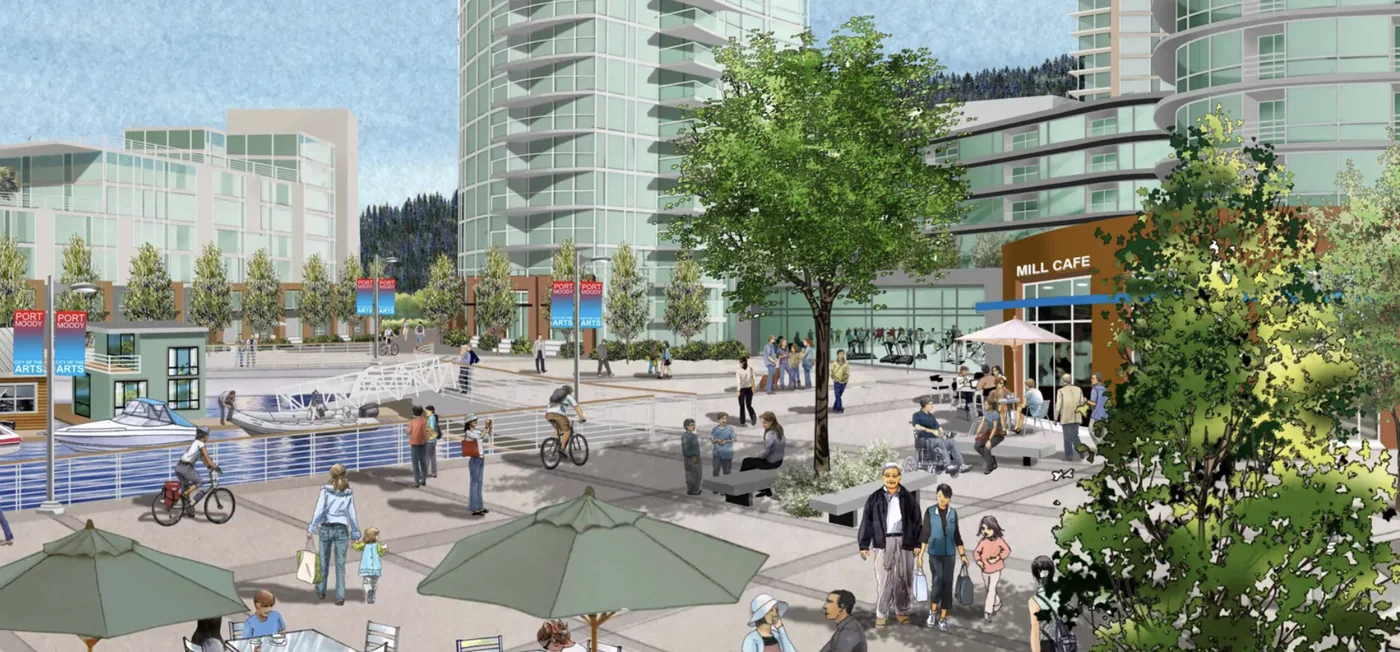
- A 1.9-acre public plaza — the gathering space, the farmers-market-on-a-Sunday space.
- About 1.3 km of new recreational trails.
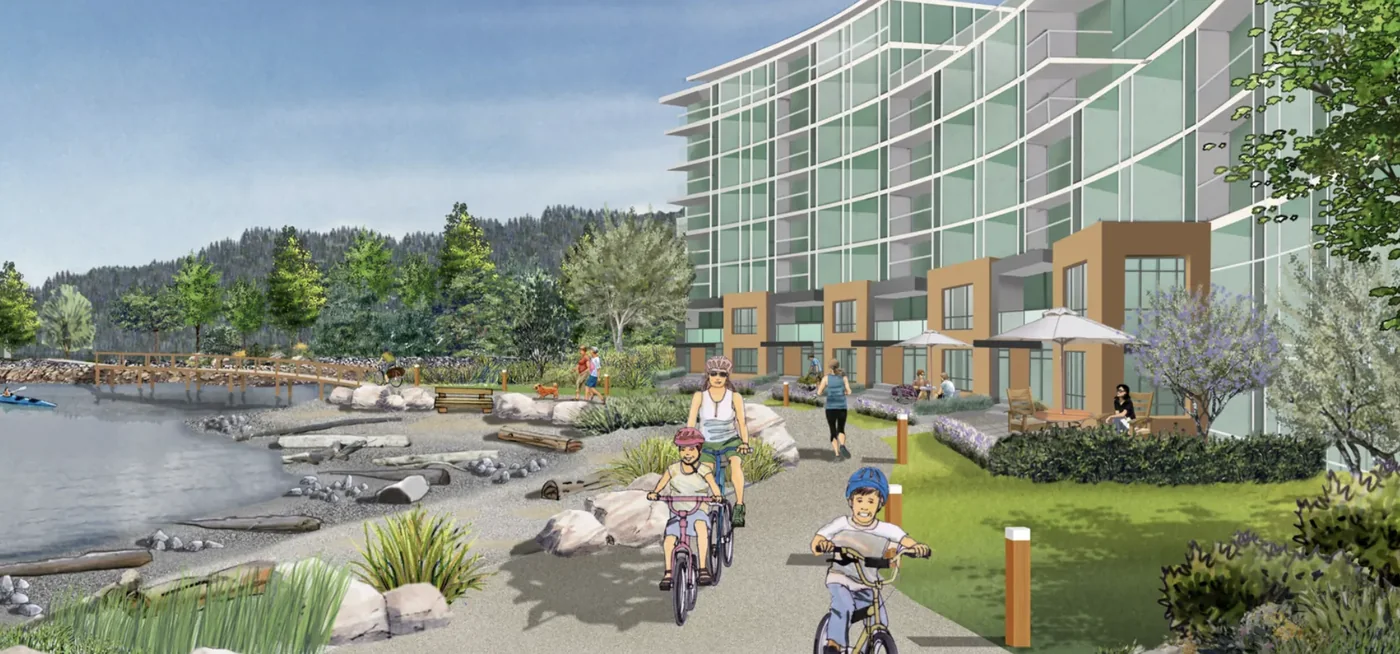
- A continuous waterfront boardwalk connecting the Flavelle frontage to Rocky Point Park — the missing east-west pedestrian link the Inlet has lacked for a hundred years.
- A Shoreline Trail extension wrapping around the entire property, increasing Port Moody's existing Shoreline Trail by approximately 43%.
The architect on record is WA Architects. The developer is Aspen Planers / Aspen Enterprises. If Flavelle is built the way it is currently envisioned, Port Moody gets a second waterfront park, a Burrard-Inlet-to-Rocky-Point boardwalk, and roughly an extra 20% population — all on the same 34 acres.
The waterfront and the boardwalk
If you live in Port Moody — or if you ever drive in from Burnaby on St. Johns and end up at Rocky Point on a Sunday — you already know what the Inlet does for this city. It is the reason Port Moody developed the way it did. It is the reason Suter Brook, Klahanie, and Newport Village hold the prices they hold. It is the reason Rocky Point Park is a regional destination, not just a local one.
What Flavelle's amenity plan adds is the missing piece: a continuous, public, walkable waterfront from Rocky Point all the way around the Flavelle site. Today that walk dead-ends at the mill fence. Under the approved plan, it does not.
Where Flavelle sits today (mid-2026)
Here is the snapshot, September 2026.
Port Moody 2050 OCP update. The bigger conversation happening right now is not Flavelle-specific — it is the 2050 OCP refresh that resets the city's planning baseline for the next 25 years. That update is heading to public hearing in January 2026, with final adoption targeted for March 2026. The Flavelle envelope sits inside that broader plan, and the 2050 update will shape what conditions, refinements, or layered requirements get carried into any future Flavelle rezoning application.
No formal rezoning application. Aspen has not yet filed a formal rezoning application for the site. That is the step that triggers detailed building heights, setbacks, traffic studies, and the public hearings most residents associate with a real project moving forward.
No construction. Nothing has been built. The site is post-mill, pre-redevelopment. If you drive past 2400 Murray Street today you see a quiet industrial parcel with a fence around it.
Council's stated stance on flexibility. Port Moody Council has repeatedly used the phrase that "flexibility will be crucial as the plan evolves." That language matters. It signals that the path from OCP designation to built towers will be iterative, not linear. Conditions will be added. Densities will be tweaked. Phasing will be negotiated. The 2018 vision is the starting line, not the finish.
The SD43 school-site episode (a case study in how iterative this is)
One worked example of the iteration: School District 43 asked Port Moody Council to formally designate a school site within the Flavelle envelope — basic future-proofing, given a build that could add 20% to the city's population. Council initially declined, citing the very real concern that they were being asked to commit a public-amenity reservation on private land that had not yet been rezoned.
SD43 then signalled that provincial intervention was a possibility — the province has tools to compel school-site reservations in master-planned communities — and council reversed. The school site was designated.
This is not a scandal; it is exactly how a 15-year master plan gets built. Every player — city, school district, developer, residents, regional government — gets to push back at the points where their interests are most exposed. The plan that gets built will not be identical to the plan that got the 2018 OCP nod. The honest read is that the broad strokes — 34-acre waterfront village, public park, density toward the upland edge, Inlet boardwalk — those are sticky. The exact unit count, tower heights, and amenity mix? Expect movement.
What Flavelle means for Port Moody real estate
This is the question every Port Moody owner, every Tri-Cities move-up buyer, and every Inlet-side investor wants answered. The honest answer has three vectors — and they do not all point the same direction.
1. The transit-oriented density premium
Port Moody's pricing — particularly in Klahanie, Suter Brook, Newport Village, and Moody Centre — already reflects a SkyTrain-walkable, Inlet-adjacent premium. A confirmed master-planned waterfront village at the eastern end of Murray Street, anchored to the same SkyTrain corridor, reinforces that premium. The pricing logic does not change. If anything, the future Flavelle amenity package — park, boardwalk, plaza, trail extension — adds to the case for being inside the 10-minute walking radius of this corridor.
2. The supply-side reality
3,397 new units phased into Port Moody is a lot of supply. For perspective, that single site at full build is comparable in unit count to the entire current Suter Brook + Newport Village + Klahanie inventory combined. Phased over 15+ years post-rezoning, the absorption math is manageable — the Tri-Cities population continues to grow, transit-oriented density is the regional policy direction, and demand for Inlet-adjacent product is structurally deep.
But it is supply. Owners holding Port Moody condos as long-run investments should not assume Flavelle is a tailwind for resale pricing in 2030 or 2032 if early-phase tower releases are priced aggressively. The same forces that make Flavelle attractive to live in could put per-square-foot ceiling pressure on the surrounding condo resale market during launch phases.
3. The lifestyle uplift
This is the under-discussed piece. Even if the timeline drifts and the unit count shrinks, the public-amenity floor that Aspen committed to — 7.54 acres of park, the boardwalk to Rocky Point, the 1.3 km of new trails, the Shoreline Trail extension — is durable infrastructure that lifts the lived experience of being in Port Moody. That uplift is the longest-running tailwind: it does not get reversed by a phase delay or a market cycle. A Port Moody with a continuous Inlet waterfront walk and a second Rocky Point's worth of park is simply a more valuable place to own a home.
The honest summary: Flavelle is a long-term tailwind for Port Moody real estate, not a 2027 listing event. Owners who already love the location have nothing to react to. Buyers waiting for "the Flavelle effect" to show up in pricing should not hold their breath — by the time it is fully in the resale comps, today's 2026 buyers will be looking at their second or third Tri-Cities move-up.
The Murray Street connection: Brewers Row, Flavelle, and the Inlet spine
Step back from the project for a second and look at the street.
Murray Street, in 2026, has quietly become the most interesting east-west corridor in the Tri-Cities. The middle of the street is anchored by Brewers Row — six operating breweries and a distillery, a quarter-mile of foot-traffic between roughly 2601 and 2821 Murray. The west end is industrial heritage (Pacific Coast Terminals, the rail lines, the working port). The east end is the Flavelle site — 34 waterfront acres on the cusp of a planning-led second act.
If you read those three pieces together, Murray Street is becoming the Inlet's main spine: a walkable, transit-served corridor that links a brewery cluster on the middle, a working waterfront on the west, and an emerging master-planned community on the east. It is the story the next generation of buyers will be living inside.
The practical implication for buyers and owners: "Inlet-adjacent" used to mean Suter Brook, Klahanie, and Newport Village. Over the next decade, it is going to mean those plus a Flavelle-anchored eastern village plus the Brewers Row middle. The geography of premium Port Moody is being redrawn — slowly, iteratively, but visibly.
What could change (the honest "downside" section)
Anyone telling you Flavelle is a sure thing in its current form is either selling something or has not read the file. Here is what could realistically change between now and ground-breaking.
- Phasing risk. 15+ year master plans rarely deliver every phase. Some phases land. Some get re-scoped. Some get sold to a different developer mid-build. The OCP envelope sets a maximum, not a guarantee.
- Market cycle risk. Tower releases that happen during soft markets get smaller, slower, or paused. A 2030 phase planned against 2026 absorption assumptions may not pencil at 2030 rates.
- Council shift risk. Port Moody municipal elections happen every four years. A council that prioritises a different mix of conditions — more rental, more affordable, tighter heights, more park — will reshape the build. The 2018 plan does not bind any future council, and council has already reserved the right to keep refining.
- Absorption risk. 3,397 new units is a lot to absorb even over 15 years. If regional supply pressure builds elsewhere — a Burquitlam tower wave, a Lougheed expansion, more Burke Mountain density — the marginal Flavelle buyer has more choice and developers price accordingly.
- Trigger-event risk. A school designation reversed once already. A waterfront park transferred to the city involves contamination remediation costs that haven't been fully scoped publicly. A rezoning conditions list that gets stricter than the developer's pro forma can absorb stalls the whole thing.
None of these are reasons to dismiss Flavelle. They are reasons to keep the conversation grounded. Master plans are directional. They tell you what the city wants to become. They do not tell you the exact form it will arrive in.
What buyers and sellers should be doing now
Three honest takeaways.
If you are buying in Port Moody right now — Suter Brook, Klahanie, Moody Centre, anywhere on the eastern Inlet — the Flavelle plan should support, not change, your buying logic. The location premium you are paying for is the SkyTrain, the Inlet, the walkability, and Rocky Point Park. Flavelle reinforces every one of those. Do not pay a premium for "future Flavelle proximity" — that premium is unrealised and unverifiable. But do not back off a Port Moody location you otherwise love because of supply concerns 15 years out either.
If you are selling a Port Moody home — particularly an Inlet-adjacent condo — your buyer is going to ask about Flavelle. Get clear, accurate answers in your hands before they do. "Approved in concept in 2018, not yet rezoned, phased over 15 plus years" is the honest one-liner. The salesy version — "the next big waterfront village" — overcommits and erodes trust.
If you are watching from elsewhere in the Tri-Cities — Coquitlam, Burke Mountain, Heritage Mountain — Flavelle is a long-run lifestyle catalyst for the whole region. A second Rocky-Point's worth of public park and a continuous Inlet boardwalk lifts the floor of what "the Tri-Cities lifestyle" means. It is not a reason to abandon your home pocket and chase Port Moody. It is a reason to keep tabs on the Murray Street story as it develops.
Considering a Port Moody buy or sell?
Get a 20-minute Port Moody read with Craig.
47+ years in the Tri-Cities. Top 1% Team — Greater Vancouver REALTORS®, 2023–2025. Top 2% Team nationwide, 2023–2025 — Royal LePage. Craig knows the Inlet pockets, the SkyTrain corridor pricing, and how to think about a long-run story like Flavelle without overpaying for it today.
Or call direct: 604-202-6092
Frequently asked questions
Where is the Flavelle Oceanfront District?
Flavelle Oceanfront District is a 34-acre waterfront site at 2400 Murray Street in Port Moody. It extends from the Burrard Inlet shoreline up to Columbia Street, bordered by Rocky Point Park to the east and Pacific Coast Terminals to the west. It is walking distance to Moody Centre SkyTrain on the Millennium Line and the West Coast Express, at the eastern end of Murray Street — the same street as Brewers Row.
Is the Flavelle redevelopment approved or under construction?
It is approved in concept only. On June 12, 2018, Port Moody Council amended the Official Community Plan to designate the site as the Oceanfront District. That is a planning-level approval — a green light on land use and density targets. The project has not yet received a formal rezoning approval, a development permit, or any construction permits. Nothing has been built. Port Moody's 2050 OCP update goes to public hearing in January 2026 with final adoption targeted for March 2026.
What does the Flavelle master plan include?
The master plan envisions up to 3,397 residential units across 11 towers (16 to 38 storeys), one 8-storey mid-rise, 75 live-work units, and 62 rental units in a low-rise rental building. It also includes about 455,000 square feet of employment-generating space (retail, office, urban light industrial), supporting roughly 1,000 on-site jobs at full build. Public amenities include 7.54 acres of new park and conservation area, four park areas, a 1.9-acre public plaza, about 1.3 km of new trails, and a continuous waterfront boardwalk connecting to Rocky Point Park. The architect is WA Architects; the developer is Aspen Planers / Aspen Enterprises.
When will the Flavelle Oceanfront District be built?
There is no verified completion date. Some marketing aggregators online cite an estimated 2028 completion — that is not confirmed and should not be relied on. Realistically, a 34-acre, 11-tower master plan of this scale is phased over 15 or more years after rezoning is approved, and rezoning has not been applied for yet. Expect the earliest phases to begin only after Port Moody's 2050 OCP is adopted and a formal rezoning application moves through council.
What was on the Flavelle site before?
The site has been an operating sawmill since 1905 — originally Emerson Cedar Mill, then Thurston-Flavelle, then Flavelle Cedar. It is one of British Columbia's longest-operating waterfront sawmills. The mill closed in late 2020 / 2021, cited by ownership as a tax and water-lot-lease decision: property taxes rose from roughly $1.6 million to $2.4 million annually, and combined with rising water-lot lease costs the annual bill approached $3 million. Aspen Planers Group owns the site; Aspen Enterprises is the real-estate arm advancing the redevelopment.
Will Flavelle increase Port Moody's population significantly?
Yes — at full build, the project could increase Port Moody's population by approximately 20%. That is why the approvals process is iterative and why the Official Community Plan flexibility language matters. Port Moody Council has repeatedly stressed that flexibility will be crucial as the plan evolves. The school-site debate with SD43 is one early example: council initially declined the school designation, then reversed after SD43 flagged the possibility of provincial intervention. This will be a multi-decade conversation, not a single approval.
How does Flavelle affect existing Port Moody waterfront real estate?
Three vectors. First, transit-oriented density premium: walking-distance proximity to a confirmed master-planned waterfront village tends to support pricing in surrounding pockets — Klahanie, Suter Brook, Moody Centre, the eastern Inlet streets. Second, supply pressure: up to 3,397 new units phased in over 15-plus years adds long-run absorption pressure that depends on market cycles and rate environments. Third, lifestyle uplift: 7.54 acres of new park, a continuous waterfront boardwalk to Rocky Point Park, and a 1.3 km trail extension all raise the neighbourhood's amenity floor. The honest read is that Flavelle is a long-term tailwind for Port Moody, not a near-term price catalyst.
Sources & Methodology
This post is built from publicly available developer information, City of Port Moody planning documentation, and local reporting:
- Aspen Enterprises — flavelleoceanfront.ca: Developer master-plan summary, public amenity commitments (7.54 acres of park, 1.3 km of trails, boardwalk to Rocky Point Park), tower count, unit envelope, employment-space totals.
- City of Port Moody — Engage Port Moody and OCP documentation: June 12, 2018 OCP amendment designating the Oceanfront District; Port Moody 2050 OCP update — January 2026 public hearing, March 2026 targeted final adoption; council statements on flexibility as the plan evolves.
- Tri-Cities Dispatch: Local reporting on the Flavelle redevelopment timeline, the mill closure context (property tax escalation from ~$1.6M to ~$2.4M, water-lot lease pressure approaching $3M combined), and the SD43 school-site episode.
- REW.ca listing aggregators: Used to cross-check publicly circulating timeline claims (including the unverified "2028 completion" figure flagged in this post as not authoritative).
- WA Architects: Identified as the master-plan architect of record.
- Craig Johnston, REALTOR®: 47+ year Tri-Cities resident with first-hand knowledge of the Murray Street corridor, the Brewers Row build-out, and the Inlet-side neighbourhoods most affected by Flavelle's long-term arc.
Methodology: any project-specific detail not directly sourced from Aspen, Port Moody, or established local reporting was omitted. The post does not quote prices, unit launch dates, or floor plans for Flavelle because none exist as legally marketable information today.
Signed: Craig Johnston, REALTOR® V99960 · Royal LePage Elite West
Want a Port Moody read tailored to your situation?
Send me your address, your shortlist, or your question. I will pull the relevant comps, map your spot against the Murray Street corridor and the Flavelle envelope, and put a structured read in your inbox within 24 hours. No pitch, no spam.
Direct: 604-202-6092 · Craig@SoldByCraig.ca