
How I Review Strata Documents for My Buyers: The Order I Read 700+ Pages In
A strata package can run past 700 pages, and most buyers don't know where to start. Here is the order I read them in, what I look for in each one, and the one-page brief my clients get at the end, with a real example.
Quick Answer
I read strata documents in a set order: 1. the Form B (fees, parking and storage, reserve fund, legal issues, alteration agreements), 2. the insurance certificate (water, sewer back-up and flood deductibles), 3. the AGM minutes and budget (what was voted on, how much fees rose, no deficit or borrowing from the reserve fund), 4. the depreciation report (what is coming in the next 10 years) along with any warranty, envelope or specialty reports, 5. the bylaws and rules, then, if all of that checks out, 6. two years of council minutes. The goal isn't to read every page. It's to find the questions that need answers before your subjects come off, and then get those answers.
Why I offer every buyer a Zoom walkthrough
The first time you open a full strata package, it is a lot. Form B, insurance certificate, financial statements, AGM minutes, two or three years of council minutes, bylaws, rules, an engineering report or two, and a depreciation report that can be a couple of hundred pages on its own. Upwards of 700 pages is common for a larger building, and it usually arrives during a subject period measured in days.
So I always offer my clients a Zoom call where I share my screen and walk them through how I review the documents. Most take me up on it. Once you see the order and know what each document is for, 700 pages stops being a wall and becomes six focused reads. The rest of this article is that walkthrough, written down.
Step 1: The Form B information certificate
The Form B is the strata corporation's official snapshot of the unit you are buying and the building around it. I start here because it is short, it is specific to your unit, and it tells me quickly whether the listing matches reality. Here is what I check:
- Strata fees. Does the monthly fee on the Form B match what was advertised? A mismatch is usually an old figure on the listing, but you want the real number before you budget.
- Parking stall and storage locker numbers. I confirm the stall and locker numbers match the listing and what the seller told you. Whether a stall is part of the title, a limited common property assignment, or simply allocated by the strata makes a difference, and the Form B is where that starts.
- The contingency reserve fund (CRF) balance. This is the building's savings account for big repairs. I note the balance here and compare it later against the depreciation report.
- Legal issues. Is the strata involved in any lawsuit, arbitration or tribunal claim? If so, I want to know who is suing whom, and what it could cost owners.
- Approved upgrades to the unit. If the current owner has an alteration agreement with the strata (new flooring, a moved wall, an added heat pump), the Form B shows it. These agreements often make the owner responsible for that alteration going forward, and that responsibility can pass to you. I want my clients to know before they buy that they may be taking ownership of an upgrade, and its upkeep.
- Money owing and special levies. Anything the seller owes the strata, and any special levy that has been approved, along with who pays it. Your lawyer or notary should confirm how that is handled at completion.
One tip: if the building has sections (common in mixed townhome and apartment complexes), the section needs its own Form B as well.
A note on square footage: strata plan vs. floor plan vs. BC Assessment
While I'm on the unit details, I check the strata plan too. Strata plans are useful, but between the strata plan, the marketing floor plan and BC Assessment, the square footage is usually different, because each one measures differently. I prefer to go by a floor plan based on laser measurements. Whatever number you use, make sure you're comparing the same kind of measurement when you look at price per square foot against other sales.
Step 2: The insurance certificate
Next I go straight to the strata's insurance certificate, and specifically to three deductibles:
- Water damage
- Sewer back-up
- Flood
The deductibles tell a story. In my experience, when a building's water damage deductible sits around $25,000, it most likely hasn't had many claims. The more claims a building makes, the higher insurers tend to push its deductibles, so a $50,000, $100,000 or higher water deductible is my cue to go looking in the minutes for why.
Two caveats. First, deductibles rose across many BC stratas after the insurance market tightened around 2019 and 2020, so a higher number isn't proof the building has problems. It is a reason to ask. Second, this matters to you personally: under section 158 of the Strata Property Act, a strata can recover the deductible from an owner who is responsible for the loss, and some bylaws go further. If a leak starts in your unit, you could be looking at that deductible. Ask your own insurance agent to match your condo policy's deductible coverage to the building's highest water deductible.
Step 3: The AGM minutes and the budget
The annual general meeting is where owners vote, including on the budget. I read the last two or three years of AGM minutes for three things:
- What was voted on, and what was only proposed. A special levy that passed is in the numbers. One that was proposed and failed, or was deferred, is often coming back.
- How much the strata fees went up. I like to see a modest increase every year. Costs like insurance, utilities, management and maintenance rise with the cost of living, so a building that holds fees flat year after year is usually underfunding something, not saving money. Since November 1, 2023, BC stratas must also contribute at least 10% of their annual operating budget to the contingency reserve fund each year, so check the approved budget does that.
- The president's report. Many AGMs include a review of the year from the council president: what got done, what went wrong and what is planned. It is often the single most readable page in the package.
Then I review the budget and financial statements themselves. I want to see that the building is not running a deficit on its operating budget, and that it isn't borrowing from the contingency reserve fund to cover everyday costs. A building that keeps dipping into its savings to pay the regular bills will have less there when the big repairs arrive.
Step 4: The depreciation report
A depreciation report is a professional study of the building's major components (roof, exterior, windows, elevators, mechanical and plumbing systems, parkade, and so on) and what they should cost to maintain, repair and replace over the long term. In BC the forecast covers 30 years, and stratas with five or more lots must get one every five years.
What most people don't realize is that a depreciation report is really a contingency reserve fund study. Its job is to help council decide how much to raise fees over time so the building can pay for big repairs from savings and limit, or avoid, special levies.
The report must include at least three funding models, usually something like a status-quo path, a moderate path and a fully funded path. Two things to know about those:
- Fully funding the plan is usually expensive. In many of the buildings I review, the scenario that avoids special levies entirely would need a much bigger fee increase than owners typically approve. That's why most buildings end up on a middle path with some levies forecast.
- You often can't tell which model council chose. Council isn't required to adopt any of them. In my experience most councils use the report as a guide rather than formally picking one, so you read it as a range of likely outcomes, not a promise.
Here is how I actually use it. Most of my clients expect to own for about five years, so I focus on the next 10 years: what is likely to come up while you own, and what the next buyer will see in this same report when you sell. A roof replacement in year 8 isn't your bill, but it will be in your buyer's Form B. It is a gauge, not a guarantee, but it's a healthy one.
One more thing: the deadline for existing Metro Vancouver stratas without a current report (none, or one received before December 31, 2020) was July 1, 2026. If a Tri-Cities building doesn't have a current report now, that is a question to ask in writing. (For the levy warning signs I look for in these reports, see my strata special levy guide.)
Other reports that matter: warranty, envelope and specialty reports
Alongside the depreciation report, I look for any other professional reports in the package:
- Warranty reports on newer buildings. New homes in BC come with home warranty coverage of 2 years on materials and labour, 5 years on the building envelope and 10 years on structure. Many stratas have an engineer review the building before each coverage period ends. If it's a newer building, I read the 2-, 5- and 10-year warranty reports and check the minutes to make sure the items they found were actually completed before the coverage ran out. Once it ends, owners pay for repairs.
- Building envelope reviews. The envelope (walls, windows, roof, membranes) is what keeps water out, and it's one of the most expensive things a strata can have to repair. An envelope review tells you its condition and what it may cost.
- Specialty reports. Elevators, plumbing, parkade membranes, electrical planning and similar reports. If the council minutes mention a report, I ask for it.
Step 5: The bylaws and rules
Bylaws and rules decide how you get to live in the building. They are always worth reading, especially if you have pets. I check:
- Pets: how many, what size, and any breed or weight limits.
- Rentals: whether rentals are allowed, any minimum lease terms, and short-term rental rules.
- Renovations: what needs approval (flooring underlay rules are common in concrete buildings).
- Everyday living: barbecues on balconies, move-in fees and booking, parking, storage, and noise.
I also cross-check the Form B for bylaw changes that have been passed but not yet filed, because they won't appear in the filed bylaws yet.
Step 6: The council minutes
If everything checks out so far, I start reading the council minutes, usually the last two years. This is where you see how the building is actually run, month to month. I'm looking for:
- Continued maintenance. Is council keeping up with routine work, or deferring it?
- Quotes being verified. Does council get more than one quote for significant work?
- No overspending. Are they living within the budget, or running short?
- Patterns. One leak is normal in a big building. The same leak discussed meeting after meeting is not.
Done in this order, the six steps give you a detailed review of the whole package without reading every page cover to cover.
What my clients receive: a one-page strata brief
Once I've reviewed the documents, I put together a one-page analysis for my clients. It answers three questions: How well is the building run day to day? Has it been maintained well? Are there likely special levies in the next 10 years?
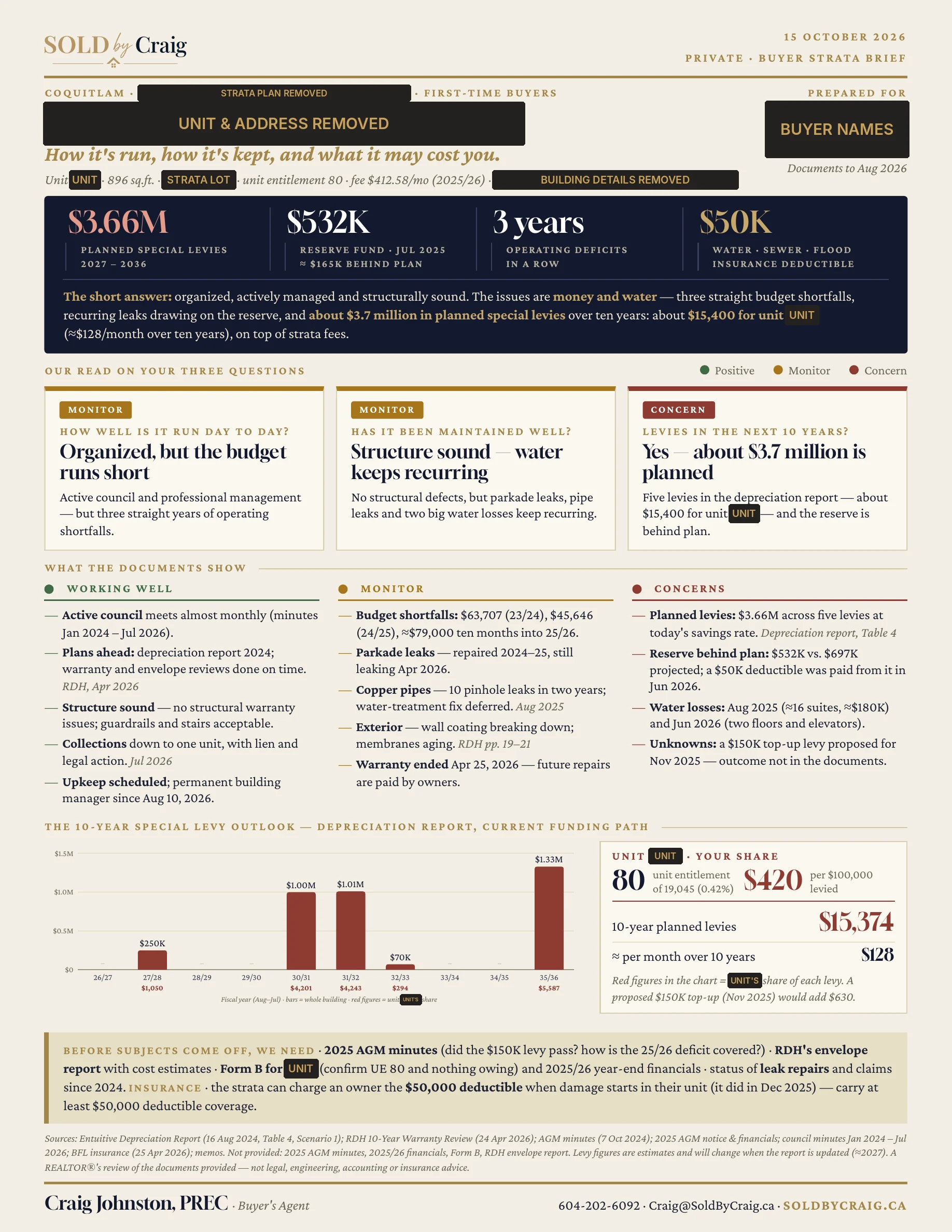
Below is the actual brief I sent to first-time buyers looking at a high-rise condo in Coquitlam in October 2026. It's the brief they received, with the buyers' names, the unit, the address, the strata plan and the building details covered. Tap the image to open it full size.
How to read the brief
- The four numbers across the top are the ones that matter most for this building: $3.66M in planned special levies over ten years, a $532K reserve fund about $165K behind the depreciation report's plan, three straight years of operating deficits, and a $50,000 water, sewer and flood deductible.
- The short answer sums it up in one sentence: organized, actively managed and structurally sound, but the issues are money and water. For this unit, the planned levies work out to about $15,400, or roughly $128 a month over ten years, on top of strata fees.
- The three questions get a plain rating: Positive, Monitor or Concern. Here it was Monitor, Monitor and Concern.
- What the documents show splits the findings into what's working well, what to monitor and what's a concern, with the document and date each one comes from, so my clients can check it themselves.
- The 10-year levy chart comes straight from the depreciation report's current funding path. The red figures under each bar are this unit's share, based on its unit entitlement (80 of 19,045, about 0.42%).
- Before subjects come off, we need lists the gaps in the package and the questions still open, such as whether a proposed $150K top-up levy passed. That list is what I follow up on next.
- The insurance note is specific to this building: under its bylaws the strata can charge an owner the $50,000 deductible when damage starts in their unit, so I tell my clients to carry at least $50,000 of deductible coverage on their own policy.
Notice that this brief doesn't say "buy" or "don't buy". It puts numbers on the risk so my clients can decide with their eyes open. For some buyers, $128 a month of future levies on a well-located, actively managed building is an acceptable trade. For others, it is a reason to negotiate or move on. Either way, they know before their subjects come off, not after.
The most important part: asking questions
Reading the documents is only half the job. The most important part of reviewing strata documents is asking questions, and having your REALTOR® follow up until you have clear answers. Gaps in the package are normal: the latest AGM minutes aren't out yet, an engineer's report is referenced but not attached, a levy was "discussed" with no outcome recorded.
Typical questions I send to the listing agent or the strata manager:
- Did the proposed special levy pass, and if so, what is this unit's share and when is it due?
- How is the current year's operating deficit being covered: a fee increase, a levy, or the reserve fund?
- Have the leaks discussed in the minutes been repaired, and were insurance claims made?
- Can you provide the engineering report referenced in the council minutes?
- Is there an alteration agreement on this unit, and what does it cover?
- When is the next depreciation report due?
This is how I help. I'm very involved with my clients' strata reviews, and I'm there to assist at every step: requesting the documents, reading them, chasing the answers and walking you through what they mean. If an answer changes the picture, we talk it through with your lawyer or notary while you still have time to act. (If you want to understand how subject periods work in BC, start with subject removal for Coquitlam buyers.)
Three timing traps I watch for
Some of the most important information in a strata review isn't missing because anyone is hiding it. It's missing because of timing. These are the three situations where I push hardest for my clients.
1. An AGM just happened, but the minutes aren't in the package
I always check the date of the last AGM. If it was held recently, the minutes may not be ready yet; in my experience it can often take a couple of weeks or more to get them after a meeting. Those minutes matter. They show what owners just voted on, including the budget, fee increases and any special levy.
So I push early. I ask the listing agent to request the minutes, or at least a written summary of the resolutions, from the strata manager as soon as our offer is accepted. If they won't arrive before subject removal, I'll recommend extending the subject date with an addendum rather than having my clients remove subjects without them. A few extra days is a small price for knowing what just passed.
2. Special levies: approved vs. proposed
Who pays a special levy is often a sticking point between buyers and sellers. An approved levy is usually straightforward to deal with in the contract. A proposed levy, one that has been discussed or put on an agenda but not yet voted on, is where it gets harder. Sellers typically want proposed levies left out (so any levy passed later falls to the buyer). Buyers want them in (so the seller pays any levy approved before completion).
Timing helps decide how hard to push. I look at when the last AGM was:
- If the AGM just happened, a vote on a new levy before completion is less likely, because another general meeting would usually need to be called. The risk to the seller of agreeing to pay any levy approved before completion is low, so I push sellers to accept it. They know the building better than the buyer does.
- If an AGM or special general meeting is coming up before completion, that is when a levy vote is most likely, and when sellers are least likely to agree. That's when the wording in the contract matters most.
However it's negotiated, it should be written into the contract clearly, and your lawyer or notary should confirm how it is handled at completion.
3. Reports that exist but haven't been released
This one is challenging. Engineering reports, depreciation report updates and envelope reviews can take months to be approved by strata council before they're released to owners. During that time, a buyer can be removing subjects on a building while a report with important findings sits unreleased.
I think it's unreasonable to hold those findings back from a buyer who is about to commit. BCFSA, Greater Vancouver REALTORS®, REALTORS® and property managers all share the goal of protecting the public. That's why I've been advocating for these reports to be released to buyers in a purchase, ahead of their release to owners if necessary. I've raised it with BCFSA and GVR in the hope of future change.
Until then, I ask directly, in writing: is there a report that has been received but not yet released, and when will it be? If the answer is yes, my clients and I talk about what that means before their subjects come off.
Normal noise vs. something to slow down for
| Usually normal | Slow down and ask |
|---|---|
| A modest strata fee increase each year | Fees held flat for several years, or a sudden large jump |
| One-off repairs and the odd leak in a large building | The same leak or system discussed meeting after meeting |
| A balanced operating budget | An operating deficit, or borrowing from the reserve fund to pay everyday costs |
| Warranty review items completed on time | Warranty deficiencies still open after coverage has ended |
| Some levies forecast in the depreciation report | A reserve fund well behind the report's plan |
| Water deductible around $25,000 | Water deductible of $50,000 or more with recent claims in the minutes |
| Bylaw amendments to update rules | Unfiled amendments affecting pets or rentals you rely on |
| A current depreciation report | No current report after the July 1, 2026 Metro Vancouver deadline |
And remember that BC's 3-day rescission period is a safety net for some purchases. It isn't a substitute for doing this homework before you commit.
Frequently asked questions
What order should I read strata documents in?
I read them in this order: the Form B, the insurance certificate, the AGM minutes and budget, the depreciation report (plus any warranty, envelope or specialty reports), the bylaws and rules, and then, if everything checks out, the last two years of council minutes. Starting with the short, unit-specific documents tells you quickly whether the deeper reading is worth doing.
What should I check on a Form B?
Check the monthly strata fee, the parking stall and storage locker information, the contingency reserve fund balance, any legal proceedings, any alteration agreement on the unit, anything the owner owes, and any approved special levies. Confirm they match the listing.
What is a good strata insurance deductible?
In my experience, a water damage deductible around $25,000 usually points to a building without many claims. Higher deductibles often follow a history of claims, though deductibles also rose across many BC stratas after 2019. Either way, ask your insurance agent to match your own policy's deductible coverage to the building's highest water deductible.
Can a strata charge me the insurance deductible?
Yes. Under section 158 of the Strata Property Act, a strata can recover the deductible from an owner who is responsible for the loss, and some bylaws set their own rules. That is why your condo insurance should include deductible coverage.
Is a depreciation report the same as a reserve fund study?
Effectively, yes. A BC depreciation report forecasts the cost of maintaining, repairing and replacing the building's major components over 30 years and includes at least three funding models, to help council plan fee increases and contingency reserve fund contributions.
Does council have to follow the depreciation report?
No. Council isn't required to adopt any of the funding models. In my experience most councils use the report as a guide, so read it as a range of likely outcomes rather than a fixed plan.
Should strata fees go up every year?
A modest increase each year is normal and healthy, because insurance, utilities and maintenance costs rise. Fees held flat for years can mean the building is underfunding repairs, which tends to show up later as special levies.
Why is the square footage different on the strata plan, floor plan and BC Assessment?
Each one measures differently, so the numbers rarely match. I prefer to go by a floor plan based on laser measurements, and to compare like with like when looking at price per square foot.
What should I look for in a strata budget?
Check that the operating budget isn't running a deficit, that the strata isn't borrowing from the contingency reserve fund to cover everyday costs, and that it is contributing at least the required 10% of the operating budget to the reserve fund.
What warranty reports should I ask for on a newer building?
Ask for the engineer's reviews done before the 2-, 5- and 10-year home warranty coverage periods ended, and check the minutes to confirm the items found were completed. Also ask for any building envelope review and specialty reports mentioned in the minutes.
What if the AGM just happened and the minutes aren't available yet?
Ask for the minutes, or a written summary of the resolutions, from the strata manager as early as possible. In my experience minutes can often take a couple of weeks or more after a meeting. If they won't arrive in time, consider extending subject removal with an addendum rather than removing subjects without them.
Who pays a special levy that has only been proposed?
It's negotiable and should be written into the contract. Sellers usually want proposed levies left out; buyers want the seller to pay any levy approved before completion. If the AGM just happened, a vote before completion is less likely, which makes it easier to ask the seller to accept. Your lawyer or notary should confirm how it is handled at completion.
How many years of council minutes should I read?
I read about two years of council minutes and two to three years of AGM minutes. That is usually enough to see patterns in maintenance, spending and recurring problems.
Sources & Methodology
The six-step order and the interpretation in this article are Craig Johnston's own process for reviewing strata documents for buyer clients. Regulatory facts were checked against the sources below. The sample brief is a real October 2026 client brief, shown as sent, with the buyers' names, unit, address, strata plan and building details covered.
- Government of BC — Strata depreciation report requirements. gov.bc.ca — five or more lots, five-year cycle, 30-year forecast, at least three funding models, no requirement to adopt one, July 1, 2026 Metro Vancouver deadline. Checked October 29, 2026.
- Government of BC — The contingency reserve fund (CRF) in strata corporations. gov.bc.ca — 10% minimum annual contribution since November 1, 2023; contributions not refundable on sale. Checked October 29, 2026.
- BC Financial Services Authority — Form B information certificate. bcfsa.ca — strata fees, alteration agreements, amounts owing, CRF, litigation, parking and storage, attachments, sections. Checked October 29, 2026.
- BCREA Legally Speaking — Liability for strata insurance deductibles. bcrea.bc.ca — section 158 of the Strata Property Act and owner deductible liability.
- Travelers Canada — New home warranties for buyers and homeowners in British Columbia. travelerscanada.ca — BC's 2-5-10 home warranty: 2 years materials and labour, 5 years building envelope, 10 years structure.
- Craig Johnston, REALTOR® (BCFSA Licence #187645). 47+ year Tri-Cities resident, Member of a Top 1% Team at Greater Vancouver REALTORS®, 2023–2025, reviewing strata documents for buyer clients in Coquitlam, Port Moody and Port Coquitlam.
Last reviewed October 29, 2026. General information only; not legal, engineering, accounting or insurance advice.
Signed: Craig Johnston, REALTOR® (BCFSA Licence #187645) · Royal LePage Elite West · Helping Tri-Cities families move up
Looking at a condo or townhome?
Send me the listing. I'll tell you which documents to ask for, and if we work together I'll review the full package, walk you through it on Zoom, and put my findings on one page before your subjects come off.
Direct: 604-202-6092 · Craig@SoldByCraig.ca