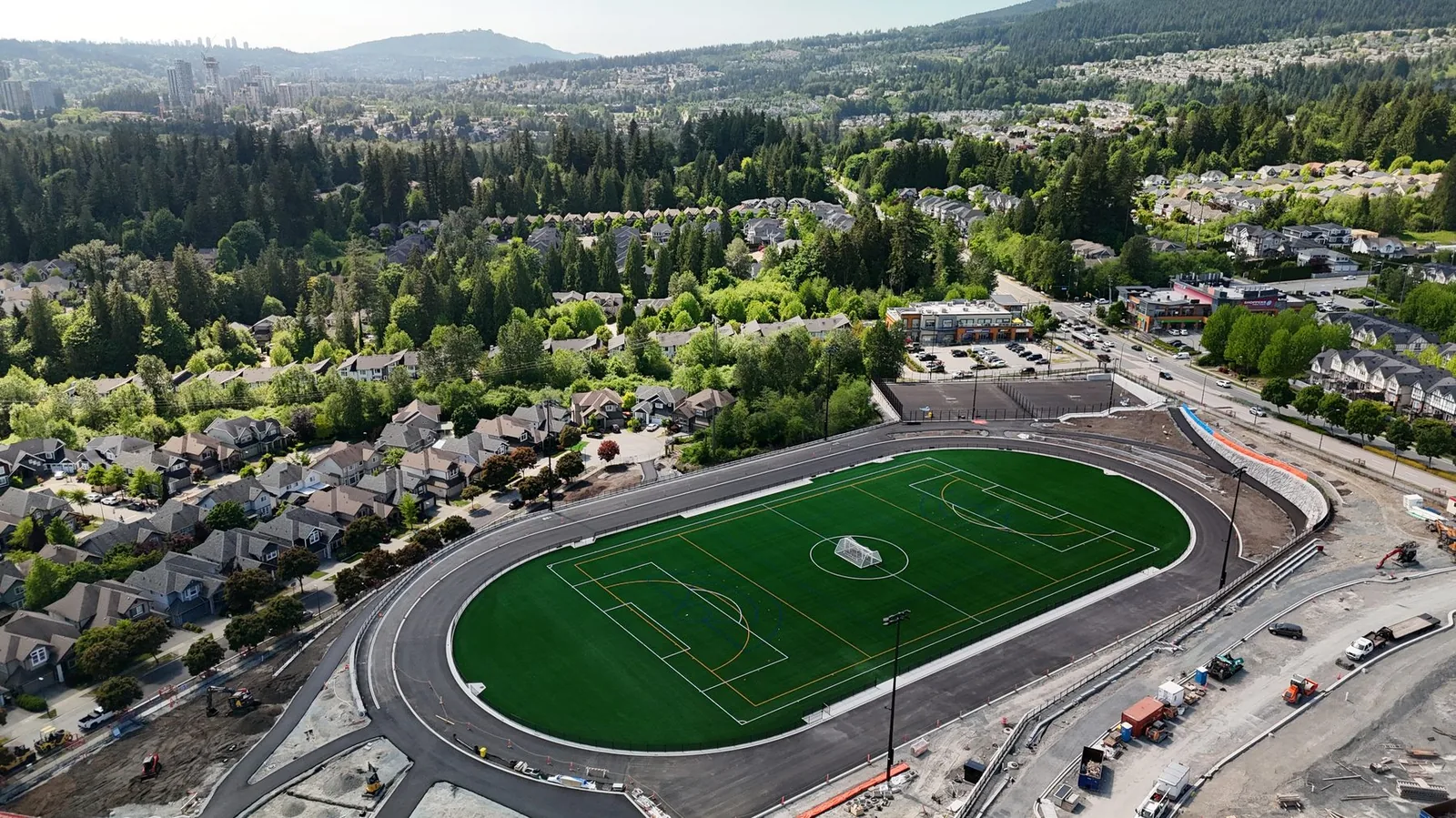
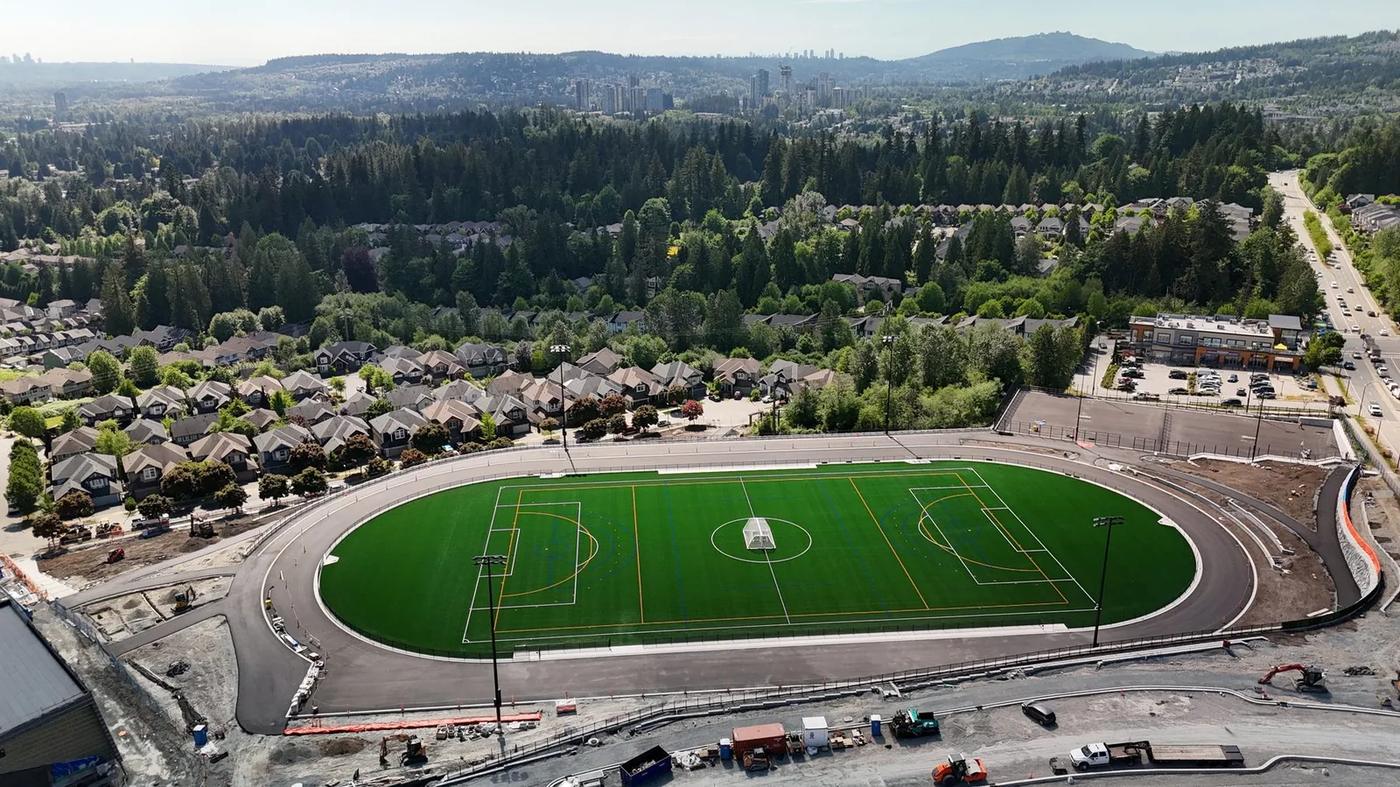
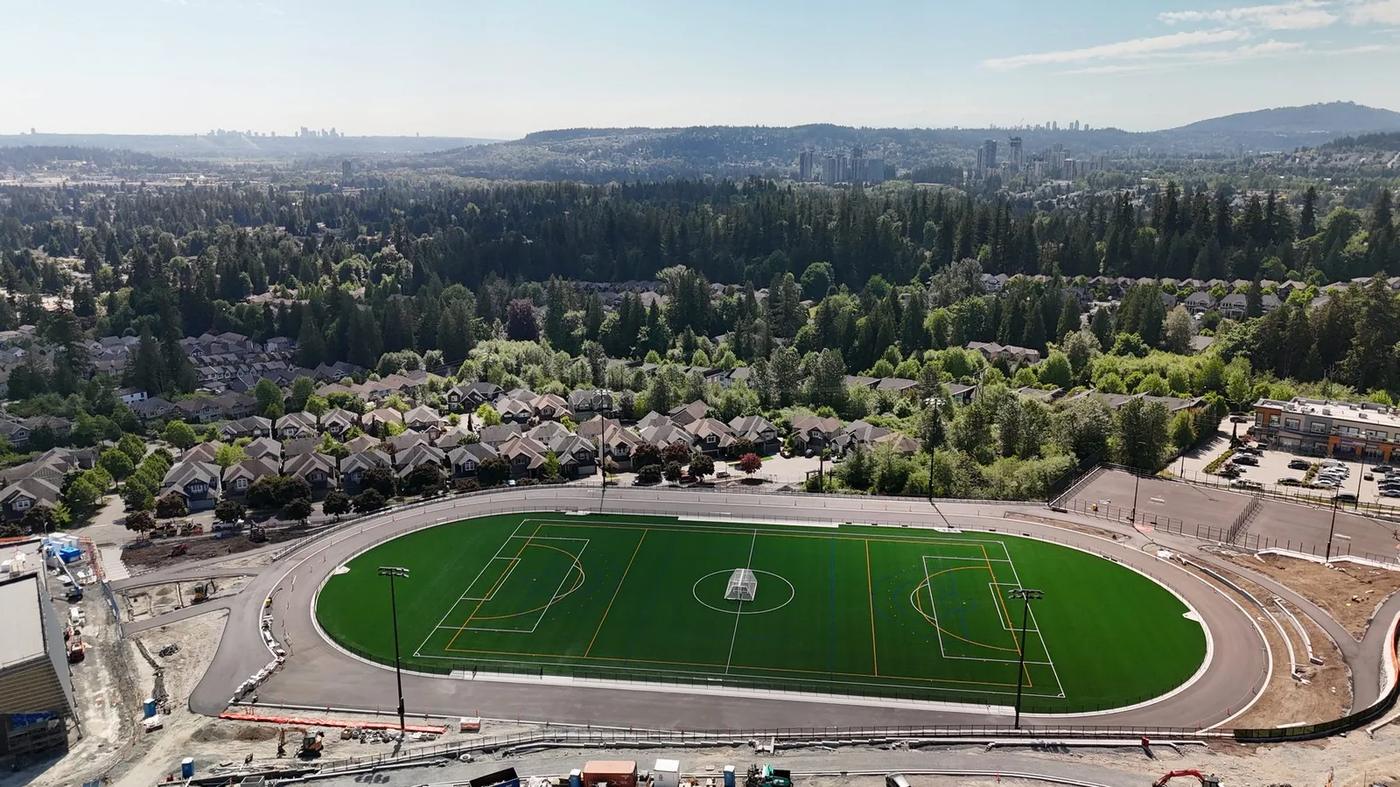
The Burke Mountain Athletic Park at 3390/3400 David Avenue is in finishing stages right now. 8.9 acres. A 400-metre rubberized track. A lit, full-size turf field. Four full-sized tennis courts. After nine years of telling clients “the mountain is still building itself,” this is the piece that changes the answer. Here’s what it actually means for your family.
Construction began summer 2025. The City of Coquitlam has it on track for completion this summer. A specific public-opening date has not been published yet.
8.9 acres on the central spine of Burke Mountain. 5–10 minutes from virtually every home up here.
400m rubberized track, lit artificial turf field for soccer/field hockey/lacrosse, four lit tennis courts, viewing areas, universal washrooms.
For nearly a decade, every Burke family who plays organized sport has driven off the mountain. The Athletic Park ends that for soccer, field hockey, lacrosse, track, and tennis.
Burke Mountain Athletic Park is the largest piece of community sport infrastructure ever built on Burke Mountain. The City of Coquitlam approved the site in 2024, broke ground in summer 2025, and as of May 2026 the construction crews are doing finishing work — turf surface, track rubberizing, lighting commissioning, paving, washroom fit-out. The City has the project on track for completion in summer 2026.
The site is 8.9 acres at 3390/3400 David Avenue. That’s the central spine of Burke Mountain, on the same parcel where School District 43 is building the new Burke Mountain Middle/Secondary School (scheduled to open September 2027). The shared site is intentional: the park and the school were designed together so the field, track and courts are available to community users in the evenings and on weekends, and to students during the school day.
For context on why this is a big deal: today, if your kid wants to run on a regulation track on Burke Mountain, the closest option is Charles Best Secondary in Coquitlam Centre — a 12-minute drive. If they play organized soccer at U10 and up, you book practice slots at fields scattered between Town Centre Park, Cottonwood, and Mundy Park — none on the mountain. Tennis lessons mean driving to Mountain View Park or down to Town Centre. The Athletic Park collapses all of those drives into one location, walkable for the schools that are already on the mountain.
For nine years I’ve told Burke Mountain buyers the same thing: the mountain is still building itself. That sentence is finally about to stop being true.
Six-lane oval plus an eight-lane 100-metre straightaway. Regulation track and field surface.
LED-lit. Lined for soccer, field hockey, and field lacrosse. Drains in any weather.
Lit courts at the northwest end of the park. Year-round evening play.
Including players’ shelters, warm-up areas, upper and lower spectator viewing zones, and universal washrooms.
A 400-metre rubberized track is the standard for competitive athletics in Canada — Athletics Canada-spec lane width, proper rubber surface that’s kind to runners’ joints over distance, and the 8-lane 100-metre straightaway is what you need for sprints, hurdles, and timed field events. To put that in plain terms: a high schooler in Burke can train on a real track without their parent driving them anywhere. A casual evening runner gets a measured loop that’s significantly easier on the body than the asphalt of Coast Meridian or Princeton.
The artificial turf is the centerpiece — and the LED lighting matters more than the surface. Burke Mountain’s climate gives you a real shoulder season; from mid-October to mid-April, you lose useable evening daylight by 5:30pm. A lit turf field means evening practice is a normal weeknight option, not a thing you give up for six months of the year. The field is striped for three sports: 11-a-side soccer, field hockey, and field lacrosse. Drainage is engineered for our wet winters, so the field stays useable through stretches that would close a grass pitch.
Four full-sized lit tennis courts at the northwest end. For context, Mountain View Park (the closest existing Burke tennis option) has two unlit courts that are useable maybe 8 months of the year. Doubling the court count, adding lighting, and putting it on a flat, central site changes tennis on Burke from a “summer-only, gotta-find-a-time” activity into something families can plan around year-round.
Players’ shelters and warm-up areas are along the field perimeter. Upper and lower spectator viewing zones — the park is built on a gentle grade, which gives you natural amphitheatre seating along one side. Universal accessible washrooms. Path connectivity to David Avenue and into the new school site. This isn’t a neighbourhood casual park — it’s a regulation training facility designed to host actual league play and school athletics meets.
I’ll be honest — the viewing ledges are the piece I’m most personally excited about. For nine years I’ve watched my kids’ games from sidelines that are the same height as the field, which means you’re standing the whole game, you can never quite see the play developing on the far side, and a quick dash to grab a coffee means missing two plays. Watching from a stepped, slightly elevated platform changes the whole experience. You see formations. You see runs off the ball. You see the game the way the coach is calling it, not the way the touchline is showing it. That sounds small. It is not small for any parent who has spent five years pacing a soccer sideline in the rain.
The Athletic Park is being built on a parcel shared with the new Burke Mountain Middle/Secondary School. School District 43’s timeline has the school opening in September 2027, with the middle school component following shortly after. This is not coincidence — the City of Coquitlam and SD43 negotiated the joint site so the same field, track and courts serve both populations.
What this means in practice:
The bigger picture: this is the model Coquitlam is moving toward across the city. Joint community-school sites maximize land use, share construction cost, and give school athletics teams a home pitch. Burke Mountain Athletic Park is the highest-profile current example. If it works as designed, expect more sites built this way in the next decade.
A regulation track and lit turf inside a 7-minute drive of every Burke home is the kind of amenity that defines a mature neighbourhood. Burke Mountain didn’t have one yesterday. It has one now.
I’ve lived on Burke Mountain for nine years. My kids do organized sport off the mountain. Most of my Burke Mountain client families do some version of the same weekly drive — Town Centre Park for field bookings, Mundy Park for cross-country, Westwood Plateau for tennis. Here’s how that calculus shifts:
This is the biggest immediate win. Coquitlam Soccer Club, Coquitlam Field Hockey, and the Tri-Cities lacrosse associations all book community fields for practice and games. Burke Mountain has not been on the booking-rotation map for these groups because there wasn’t a lit, full-size field to book. Starting fall 2026, that changes. Expect Burke Mountain’s share of practice and game slots to rise significantly, which means less driving on Tuesday and Thursday evenings for every Burke family in these sports.
I’ll admit — this one is personal. My kids are so pumped for this. We’ve spent every soccer season driving down the mountain in the dark to practice, then back up the mountain for dinner that’s an hour later than it should be. Once the turf is open, that flips. They’ll be out all evening playing soccer on a real lit field, ten minutes from home, with friends who live on the same streets. That’s the thing I’ve been waiting for since we moved up here. If you have a kid in soccer or field hockey and you’ve been doing the same drive, you’ll feel this one in your bones.
Charles Best Secondary’s track has been the de facto training venue for Coquitlam runners. With a regulation 400m rubberized track on Burke, that shifts. The track is also a meaningful lifestyle amenity for adults — evening runs on rubberized surface, year-round in the lit hours, on a measured loop. If you’ve been running the Coast Meridian and Princeton shoulder for years, you’ll feel the difference in your knees within a week.
Four lit courts changes the equation. Today, if your kid wants weekly tennis lessons on Burke, the answer is “summer only, and good luck booking a court.” Starting summer 2026, that becomes “year-round, four courts, lit play after work.” For Burke seniors and retirees who play casually, this is a meaningful expansion of weekly social options.
The presence of regulation facilities changes which sports kids actually try. If track, soccer, field hockey, lacrosse, and tennis are all suddenly walkable, you’ll see more Burke kids trying each of them. The infrastructure shapes the participation rates in a way that’s well-documented in municipal-recreation literature.
The walkable amenity story is the underrated piece. A lot of the “is Burke isolated when I’m not driving to school anymore” conversation I have with downsizing clients gets easier when there’s a track to walk, lit tennis courts, and a viewing area to bring grandchildren to. It doesn’t solve everything, but it shifts the answer.

The Athletic Park isn’t happening in a vacuum. It’s landing on top of a neighbourhood that has been adding pieces, year after year, since around 2018. Here’s the rough timeline I share with clients to explain how Burke is graduating from a new subdivision into a mature neighbourhood:
That’s a 9-year arc from raw subdivision to amenitied neighbourhood. Buyers who bought on Burke in 2018 are now living through the back half of that arc — they bought the “new build, limited amenity” product and they’re receiving the “mature neighbourhood” outcome. For buyers entering today, the Athletic Park is the largest single visible piece arriving in the next 12 months.
This is also why I’ve been telling move-up buyers — families upsizing from a Port Moody condo or a Coquitlam townhouse into a Burke detached — that the “Burke is too far from everything” objection is increasingly out of date. Burke vs. Westwood Plateau is no longer the trade-off it was three years ago. Burke vs. Heritage Mountain increasingly comes down to lifestyle preference and home age, not amenity gap.
Three things worth flagging, because I see them in client conversations almost every week:
It’s not. It’s a regulation training facility shared with a high school — designed for organized sport, school athletics meets, and league play. There’s no playground equipment, no spray park, no picnic shelter, no off-leash dog area. For toddler-age daily play, Galloway Park, Queenston Park and Riley Park are still your everyday spots. Don’t buy a Burke home expecting the Athletic Park to be your 4-year-old’s weekend playground — that’s not what it is.
The Athletic Park is a community-school shared site. Once the secondary school opens in September 2027, the fields will have priority use windows during weekday school hours. Public bookings work around that. The City’s Park and Facility Booking system will handle scheduling — don’t plan around fully open community access during 8am–3pm weekdays once school is in session.
There’s a meaningful difference between “this facility is real, funded, and under construction” (which it is) and “this facility is open and affecting daily life” (which it isn’t quite yet). For a home you’re buying to live in for 5+ years, factor it in. For a flip horizon under 18 months, the surface is still being commissioned. Be honest with yourself about which timeline you’re in.
Greater Vancouver REALTORS® guidelines, the Competition Act, and BC Financial Services Authority rules prohibit me from telling you that the Athletic Park will increase your home value by a specific percentage. I won’t. Nobody who promises you that number is being honest — no one can isolate that variable cleanly from interest rates, broader market cycles, and the dozens of other inputs that move at the same time.
What I can tell you is what I observe in buyer behaviour:
Whether any of that translates into a specific dollar figure on your home depends on your street, your home’s condition, broader market timing, and how the listing is priced and marketed. Which is exactly the conversation I’d rather have on a strategy call than in a blog post — because I can’t reasonably answer it without knowing your address and your timeline.
I’ve lived on Burke Mountain for nine years and worked the Coquitlam, Port Moody and Port Coquitlam market as a REALTOR® since 2017. The Athletic Park is a 4-minute drive from my house. The notes in this post are written from inside the neighbourhood, not pulled off a brochure. If you’re weighing a Burke Mountain move and want a straight read on how all this changes your decision, you can book a 20-minute strategy call here.
The pages below go deeper on the specific decisions a Burke Mountain buyer or seller is making right now.
The main pillar page — everything Burke Mountain in one place.
What daily life actually looks like up here, by a 9+ year resident.
Where Burke families go on weekends — and the playgrounds that matter most by age.
Smiling Creek, Pinetree Way, the new Middle/Secondary, and how catchments work.
The honest comparison for move-up families weighing both options.
Why choosing a Burke Mountain specialist matters — and how to evaluate one.
The commercial heart of Burke Mountain — build-out timeline, what’s coming.
The boutique 23-townhome collection steps from Smiling Creek and the Athletic Park.
For families moving in from Vancouver, Port Moody, or out of province.
Whether you’re buying into Burke ahead of the Athletic Park opening, selling into the new amenity story, or just deciding whether Burke fits your family — let’s have a 20-minute call.
Craig Johnston, REALTOR® V99960 · The MACNABS · Royal LePage Elite West · 604-202-6092