
The 30-second read
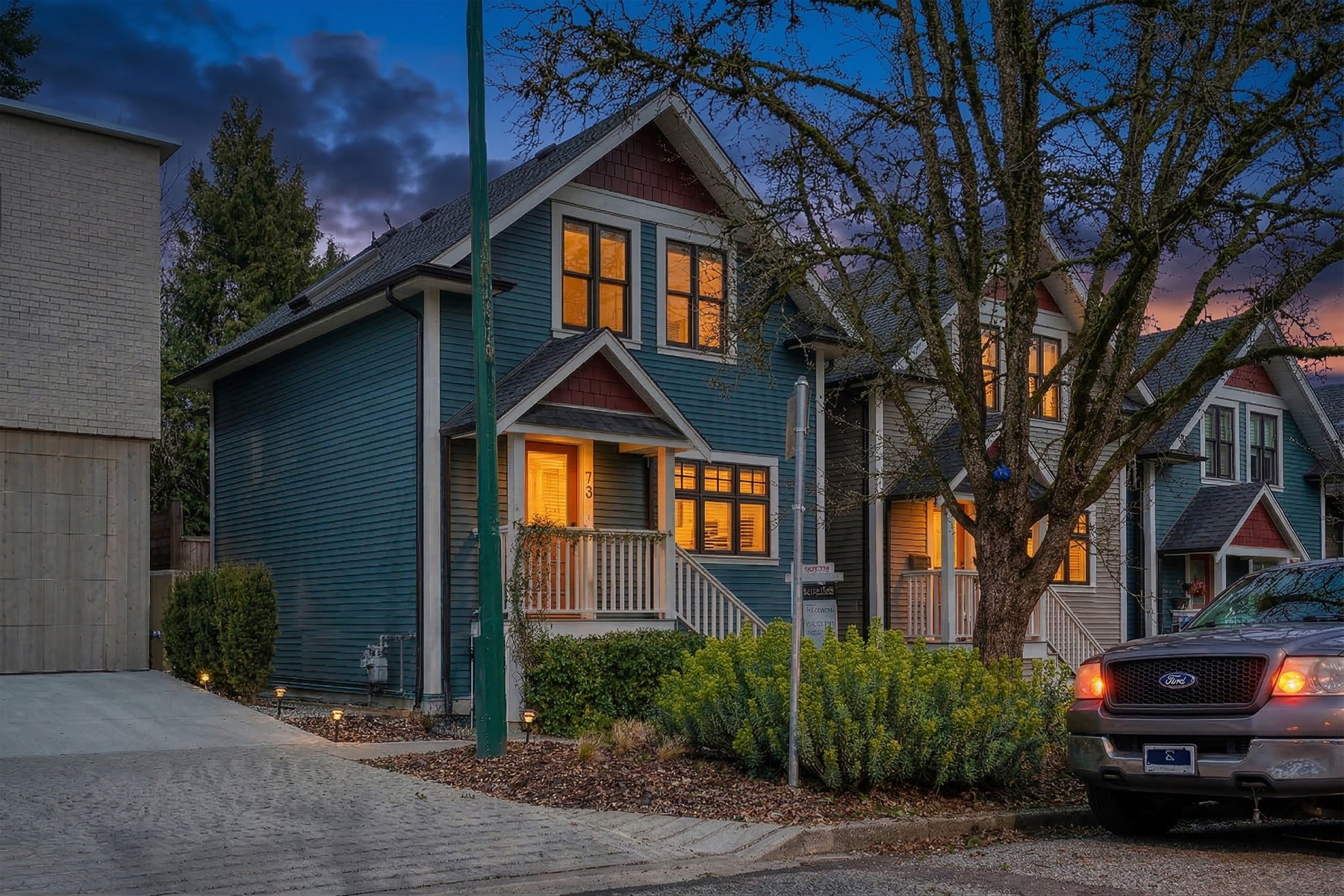
This is a buyer-side story. The home is 73 E 27th Avenue — a detached three-storey character home on the west side of Main Street in Vancouver East, and one of only five “Shirley Houses” on the Vancouver Heritage Registry. RE/MAX Select Properties listed it at $1,798,000 on April 28, 2026. Six days later it was under contract to my clients, Susie and Hans, at $1,760,000 — $38,000 below ask.
The headline number understates the work. Susie and Hans came to me after losing confidence with another REALTOR®, referred by a friend who is a recent client. They are first-time buyers. The listing side ran a tight process. The home was always going to attract serious buyers fast. The job was to write a clean offer that won the home, hold the line on the terms that mattered, navigate a list-side counter that crossed out portions of the contract, and keep everyone calm when the buyer’s home insurance approval was still pending hours before subjects had to come off.
It came together. The full client narrative is published as the Susie & Hans case study on the case-studies page. This post is the property and the playbook — how disciplined buyer representation produced an under-asking purchase in a Vancouver pocket where most buyers pay at or above list.
The property — why this Shirley House is essentially unrepeatable
The Shirley Houses are a small group of historically significant homes recognised by the City of Vancouver on its Heritage Registry. 73 E 27th is one of five. That status is the part of the story most buyers underweight when they’re focused on price-per-square-foot. Heritage Registry homes are a fixed, finite supply. You can not build another one. When character-led buyers eventually decide they want one, they are competing for a tiny inventory that does not grow.
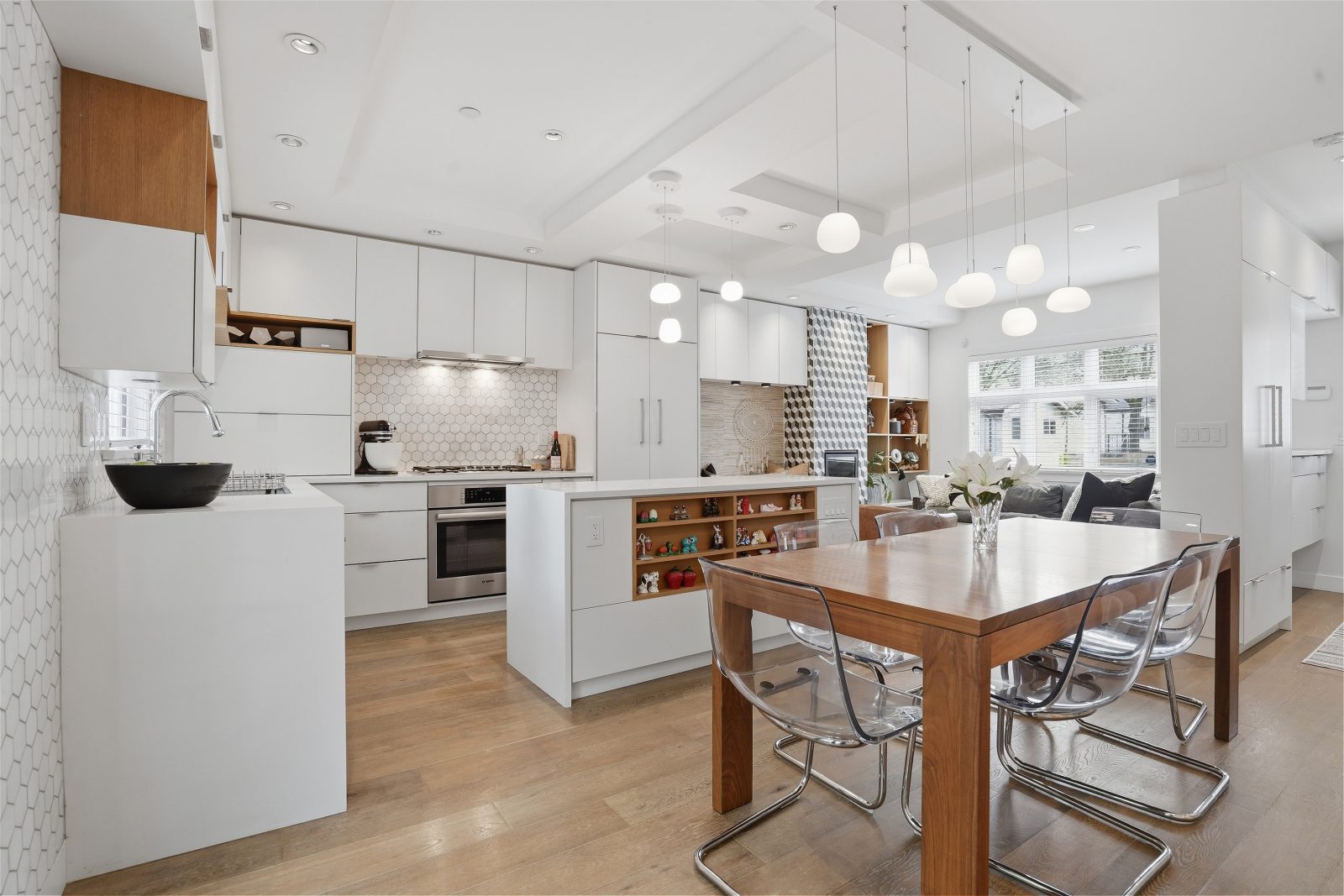
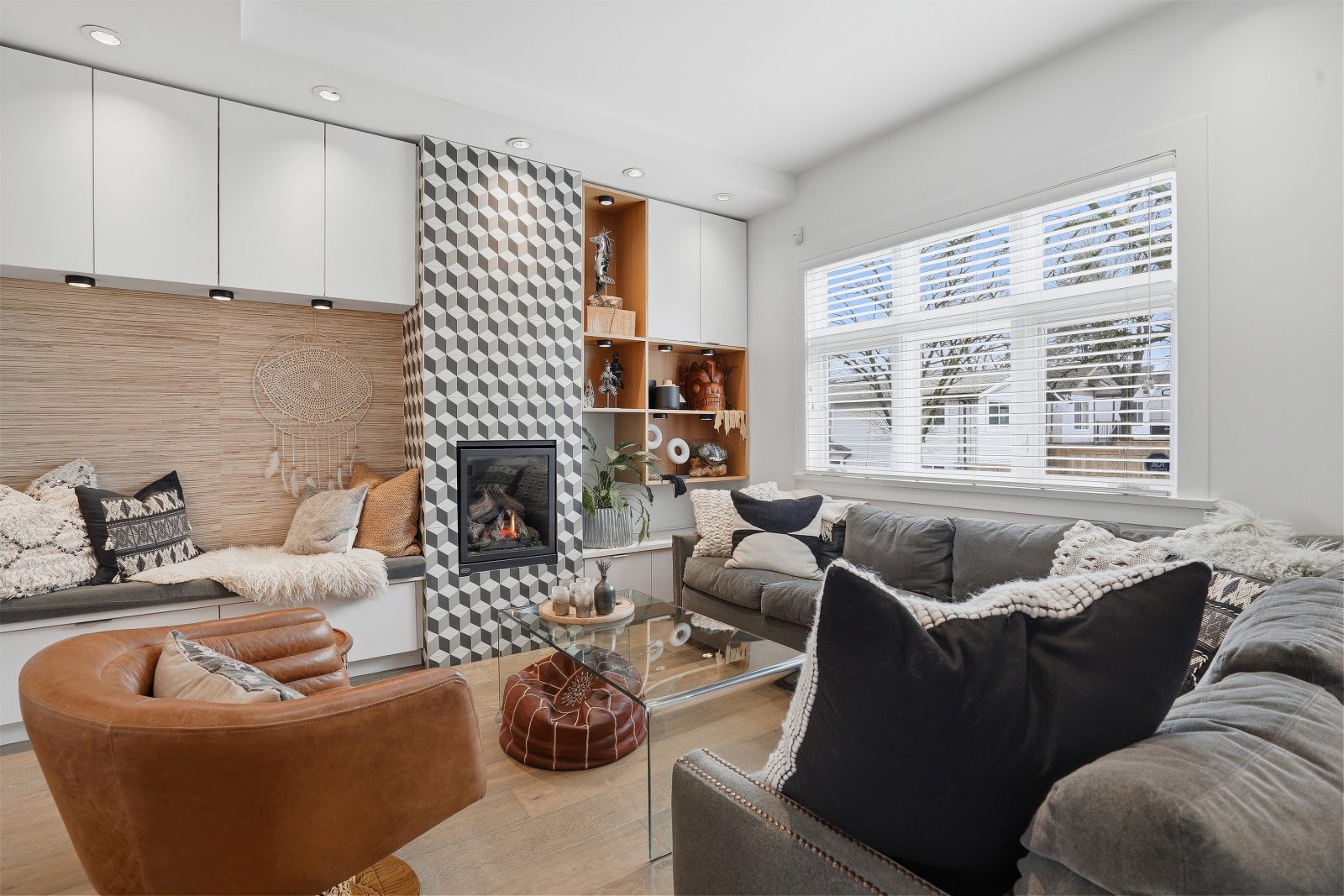
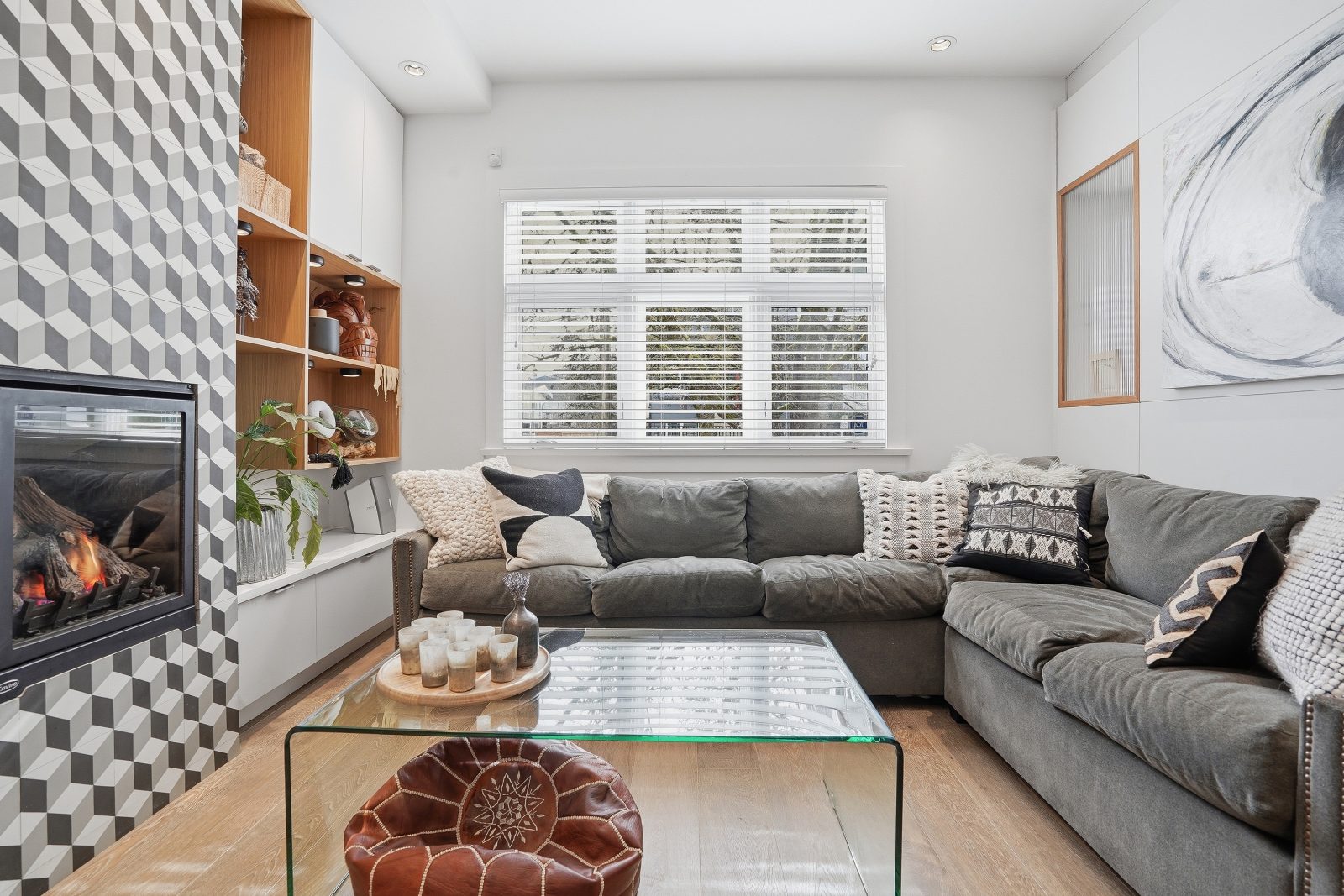
The home itself reads as both period and modern. Built in 2006 and then taken down to the studs in 2017 with full City of Vancouver permits, the renovation produced a bright open floor plan with custom millwork throughout. Both upper bedrooms have ensuites with heated floors. The primary opens to a vaulted walk-in closet and dressing room. The lower level is fully finished with a third bedroom or media room, a full bath, and laundry. The mechanical package is current — central air, in-suite laundry, natural gas fireplace.
Square footage is 1,513 across three levels: 507 main, 499 above, 507 finished below. That is a working family footprint in a city where the buy-in for a true detached home this far west typically starts well above this number. Outside, the backyard is set up as year-round living space with a custom canopy and firepit. There is no private parking — street permit parking out front — a fair trade for this location and not the kind of thing that should derail a serious buyer in this pocket.
The neighbourhood — West of Main, one block to General Wolfe Elementary
Location does more work here than any feature inside the home. The Riley Park / Main Street corridor west of Main is one of the most consistently desirable pockets of Vancouver East. The block-by-block character is intact, the food and coffee scene on Main Street is the city’s best in its price band, and Cambie Street is a five-minute drive west. Downtown is a 15-minute SkyTrain ride from King Edward Station.
For Susie and Hans, the school catchment was a real factor. 73 E 27th is one block from General Wolfe Elementary — a long-standing neighbourhood school they wanted to be inside the boundary for. Walking distance to school is the kind of small-radius decision that compounds across years of family life and is genuinely hard to reverse with a future move. The school proximity was not a marketing line on the MLS; it was an actual decision criterion.
The backyard — year-round outdoor living, custom canopy, firepit
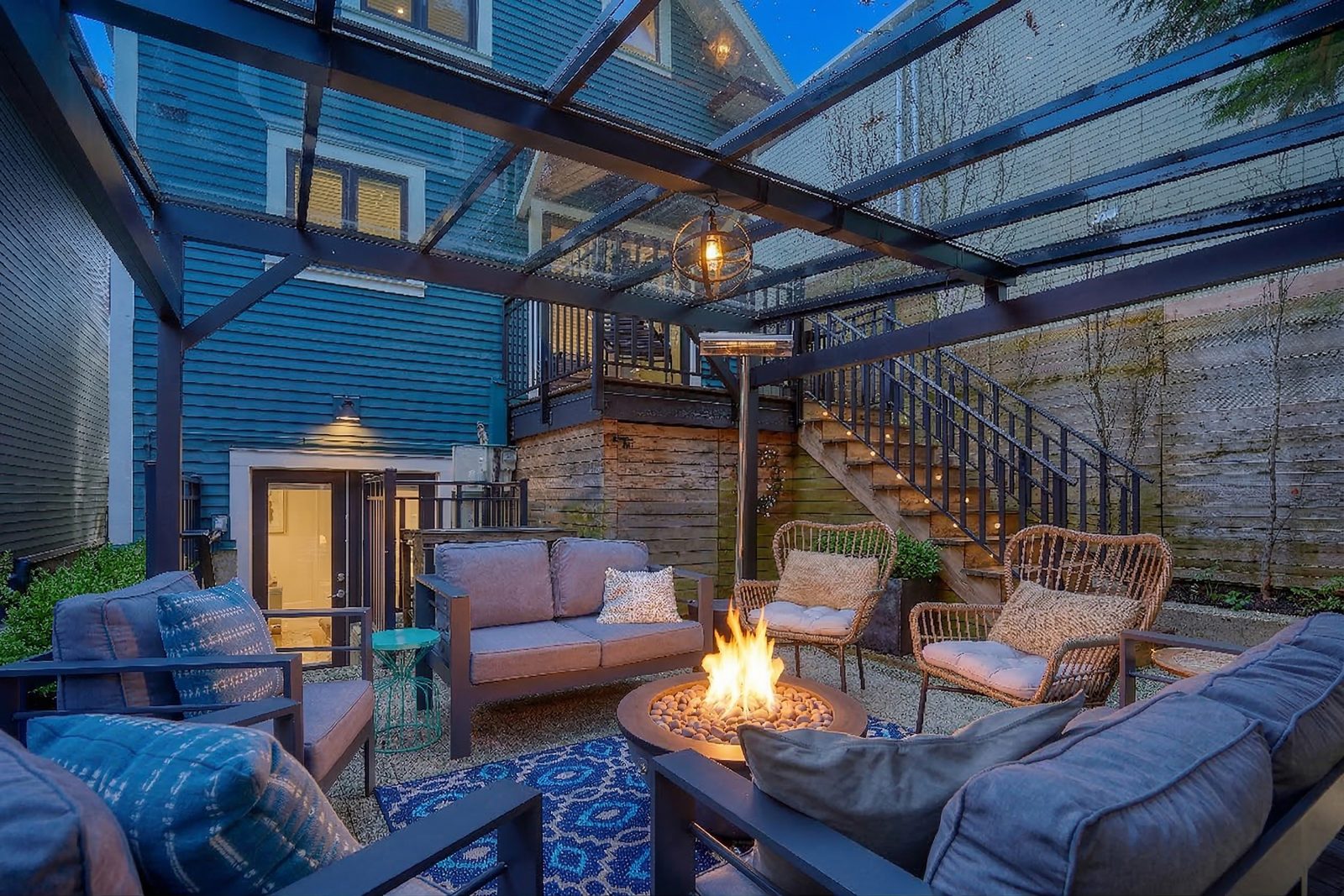
The MLS listing buried it in a single line: “The backyard is an ideal year round living space with custom canopy + firepit.” In person it’s the room that sells the house. On a Vancouver lot, outdoor space is the scarcest square footage a home can deliver, and what the previous owners built here is genuinely uncommon — a fully covered, gas-firepit-anchored outdoor living room that functions across the calendar, not just for three weeks in August.
The bones: a custom steel-and-glass pergola canopy stretches across most of the rear yard, keeping the seating area dry through Vancouver’s wet months while still letting natural light through. An overhead orb pendant adds warmth at night. A vertical patio heater extends usable evenings well into shoulder season. Beneath it, a large round gas firepit with decorative stones grounds the conversation circle.
The layout is set up for actual entertaining rather than for the photo. Two large outdoor sofas, four wicker accent chairs, and side tables form a U around the firepit. Patterned rug and patio-stone underfoot soften it. A privacy fence with mature trees beyond, plus string lights running up the staircase, complete the room.
For buyers like Susie and Hans — weighing trade-offs in a market where every detached home this far west is making someone compromise on something — a real outdoor room they could use ten months a year was a quiet but meaningful tilt in the home’s favour. It is not a feature that shows up on a spec sheet next to bedroom count and square footage, but it’s exactly the kind of feature that changes how a family actually lives in the home.
The buyers — almost out of patience before they reached me
Susie and Hans reached out on April 1, 2026, on a referral from a friend and recent client of mine. They had been working with another REALTOR® and had lost confidence. What started as a simple introductory text turned into a friendly, professional phone call that took the temperature down within minutes. From the first conversation they were not hiring a REALTOR® in the transactional sense — they were rebuilding trust in the process.
First-time buyers are the easiest clients to under-serve and the hardest to serve well. They have the most at stake emotionally and financially, the least direct experience to anchor against, and the smallest tolerance for mistakes. Our job in the first few conversations was less about properties and more about resetting their mental model: what a buyer’s agent does and does not do; how the offer process actually unfolds; where the real risk points are; what they could expect from me and from the system around us. Within a few weeks they were focused, calm, and house-hunting from a position of confidence rather than anxiety.
The strategy — disciplined buyer rep in a fast pocket
73 E 27th hit the market on April 28, 2026 at $1,798,000. From the first walk-through it was clear this was a serious contender. The character, the renovation quality, the school catchment, and the rarity factor of a Shirley House aligned with exactly what Susie and Hans had been hunting. The risk was the obvious one: every other serious buyer would see the same things, and Vancouver West-of-Main does not sit on the market for long.
The strategy was three pieces:
- Know the walk-away number before writing. Susie and Hans set a hard ceiling with me, in writing, before we drafted the offer. That clarity is what kept the negotiation calm. There was a real price we were not going past, and we both knew it, so every back-and-forth was inside a defined zone instead of a moving target.
- Write clean enough to be taken seriously. In this market and this neighbourhood, the listing agent is looking at multiple offers within the first weekend. An offer that looks fussy gets discarded first. We wrote with the protections Susie and Hans actually needed — subject to financing, inspection, insurance, and document review — with reasonable removal timelines and a deposit posture that signalled credibility.
- Negotiate the counter clause-by-clause. The listing side did what good listing agents do: they crossed out portions of our contract and countered. The reflex of a weaker buyer’s agent is to either accept the redline whole or push back broadly. The right move is to understand why the seller wanted each change, then carefully revise the wording so the seller’s legitimate concern is satisfied without giving up the buyer’s protections. We worked the contract that way line by line until both sides could sign.
Final accepted price: $1,760,000 — $38,000 below the $1,798,000 list. In a Vancouver pocket where comparable detached homes routinely sell at or above asking, that is a meaningful gap, and the entire gap was created by buyer representation. Without it, the same buyers in the same market with the same target home would almost certainly have paid more.
The 5pm cliffhanger — insurance approval on subject-removal day
This is the part of the deal that does not show up on the MLS.
Heritage Registry homes can occasionally complicate the home insurance process. Insurers want to confirm replacement cost and any heritage-related restoration obligations before issuing a binder. On the day subjects had to be removed, Susie and Hans’ insurance approval still had not landed. A weaker scenario plays out one of two ways from there: panic and try to extend subjects (signalling weakness to the listing side and creating renegotiation risk), or remove subjects without confirmed coverage (taking on financial exposure that nobody should accept).
The right move was neither. The likeliest outcome was that insurance would be approved — the open question was simply the premium and conditions. I kept the buyers calm, kept the listing side informed at a high level without compromising our position, and worked the insurance side hard through the afternoon. Confirmation landed just before 5:00 PM. We submitted subject removal immediately. Susie and Hans had officially bought their first home.
The result — a heritage home, on the school block, $38,000 under asking
The bare facts on title are these: 73 E 27th Avenue, sold $1,760,000 against a $1,798,000 list, 6 days on market, accepted under disciplined buyer representation. The qualitative outcomes are larger. Susie and Hans own one of five Shirley Houses on the Vancouver Heritage Registry, one block from General Wolfe Elementary, with the 2017 renovation already done and the mechanical package already current. They will not be renovating, re-renovating, or apologising for the home to friends and family for years. The home was already the right one when we found it.
Their own words afterward, lightly edited: “Craig never once pushed us. He simply managed the process, protected us, educated us, and gave us confidence every step of the way.” The full Susie & Hans case study — including the part about how the relationship began after another agent had let them down — is published on the case studies page.
Read the full Susie & Hans case study → See the full listing →
The lesson — what buyer representation actually buys you
If you take one thing from this story, take this: in a hot Vancouver neighbourhood, a strong buyer’s agent is not a tour guide. The listings are publicly available on every consumer app. The price information is publicly available. What is not publicly available is the discipline to set a walk-away number before writing, the craft to draft a clean offer that gets taken seriously, the patience to work a counter clause-by-clause without surrendering protections, and the steady hand to hold a deal together when something goes sideways on subject-removal day.
That is what your agent is for. It is the difference between paying $1,798,000 and paying $1,760,000 on the same home. It is the difference between removing subjects without insurance because you panicked and removing them at 5pm with confirmation in hand. It is also, just as importantly, the difference between buying the right home and buying a home you talk yourself into because you were tired.
Susie and Hans were able to step into 73 E 27th with the home, the neighbourhood, the school, the heritage, and the price all aligned — not because they got lucky on day 6, but because the process had been built well in the weeks before.
If you’re house-hunting in Vancouver or the Tri-Cities
If you are looking at a fast-moving pocket — West-of-Main, Riley Park, Cambie corridor, Burke Mountain, Westwood Plateau, Heritage Mountain, central Coquitlam — the case for having your own representation is the same. The conversation worth having is whether your search strategy, your walk-away number, your offer template, and your subject-removal playbook are all set up to produce a result like the one on 73 E 27th — or whether they are leaving money and risk on the table.
A 20-minute Strategy Call is enough to walk through your situation, look at the homes you have been watching, and tell you honestly what the right next move is.